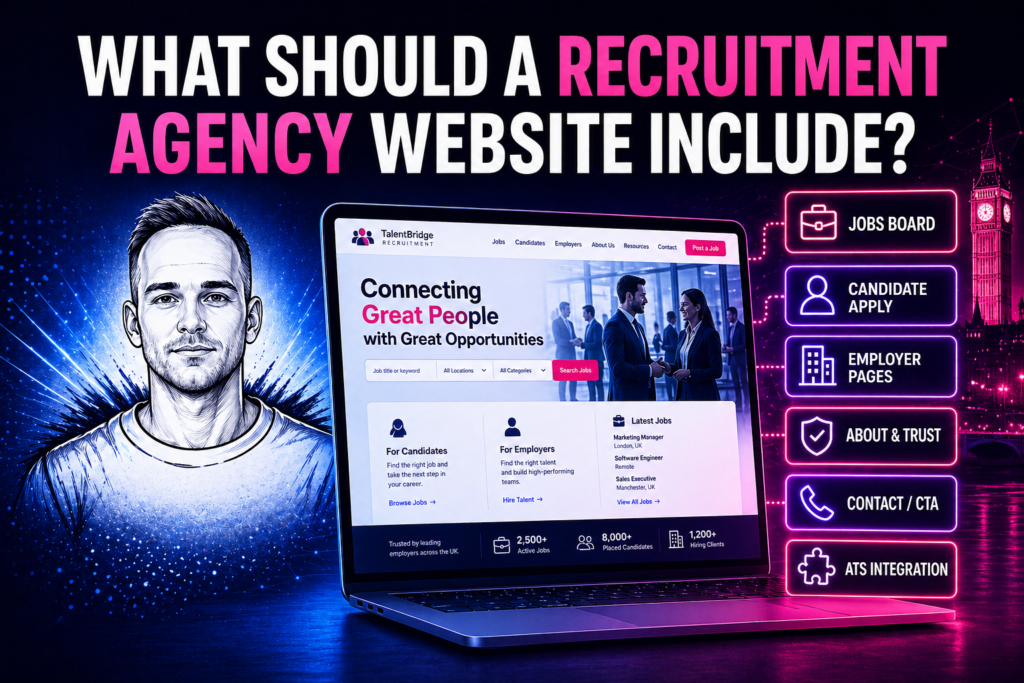
Most recruitment agency websites underdeliver on one of two fronts: they look professional but give candidates nowhere useful to go, or they have a job board but nothing that persuades employers to make contact. A recruitment website has to do both jobs at once, for two very different audiences, often on the same page.
This post covers what a recruitment agency website actually needs — the pages, the functionality, the content and the technical elements that separate a site that generates business from one that just exists.
The core pages
Homepage
The homepage has two jobs: communicate clearly what your agency does and who for, and direct both employers and candidates to the right place. A split path — “I’m looking for talent” and “I’m looking for a role” — works well for agencies with distinct candidate and client audiences. For smaller agencies where the audiences overlap more, a single direct pitch with a job search above the fold can work just as well.
What kills a recruitment homepage: generic stock photography of handshakes, vague positioning statements (“your trusted recruitment partner”), and a hero section that says nothing specific about your sectors, locations or what makes you worth calling.
About page
Candidates and employers both want to know who they’re dealing with. For a smaller agency or a founder-led business, a direct first-person about page performs better than a corporate “our mission” statement. Name the founders, name the consultants, show actual people. Recruitment is a relationship business — anonymity works against you.
Sector pages
One page per sector you recruit in. These are some of the most valuable pages on a recruitment website from an SEO perspective, and they’re frequently missing or underdeveloped. A finance recruitment agency with no “Finance Recruitment” page is missing the most obvious search traffic it could receive.
Each sector page should explain what roles you cover within that sector, the types of clients you work with, what candidates can expect from the process, and link to live jobs in that sector. Thin sector pages — two paragraphs and a list of job titles — are barely better than no page at all. Four to six hundred words of specific, useful content is the minimum worth publishing.
Services pages
Separate from sector pages, services pages cover how you work — permanent placement, contract, executive search, RPO, retained search. Not all agencies need separate pages for each service, but if you offer meaningfully different things to different types of client, separate pages make it clearer and help search engines understand your offering.
Contact page
The contact page needs to serve both audiences. An employer contact form and a candidate contact form or CV upload should both be accessible. A phone number. A physical location if you have one — especially important for local search. Response time expectations reduce anxiety for both audiences.
Job board functionality
The job board is the most important candidate-facing element of the site. At minimum it needs: filtered search by sector, location and job type; individual job pages with a complete description; a per-vacancy application form with CV upload; and an automatic acknowledgement when an application is submitted.
Every job page should have a clear title, location, salary, employment type, and a description that tells a candidate whether they should bother applying. Job pages that just paste the internal job spec with no editing do not convert well and do not rank well.
For how the job board connects to your ATS, see the post on recruitment websites with a job board.
Employer-facing content
Most recruitment websites are built almost entirely for candidates and then wonder why employers don’t enquire. Employers visiting your site want to know: what sectors do you cover, what does your process look like, how quickly can you fill roles, what do you charge, and what have you done for similar clients.
A short employer enquiry path — a dedicated page for hiring organisations with a form that asks for company name, what they’re looking for, and the best way to contact them — converts significantly better than sending employers to the generic contact page.
Case studies and client testimonials belong on the employer section of the site. Specific examples (“placed 12 finance professionals across three London offices in Q3”) outperform generic statements (“we pride ourselves on quality candidates”).
Technical elements
Mobile performance. A significant proportion of candidate traffic comes from mobile. Job listings that load slowly or application forms that don’t work on a phone lose applications. Mobile-first design is the right approach.
Page speed. Google uses page speed as a ranking factor. A recruitment website with high-quality images that haven’t been optimised, or heavy page builders that load unnecessary code, will underperform against a leaner build.
Schema markup. JobPosting schema on individual job pages makes them eligible for Google for Jobs — the job listing carousel at the top of search results. This is one of the most underused opportunities on recruitment websites and one of the most straightforward to implement on a properly built WordPress site.
SSL and GDPR. CV uploads and application forms collect personal data. An SSL certificate is a minimum. A clear privacy policy covering what you do with candidate data, how long you keep CVs, and candidate rights under GDPR is a legal requirement, not optional.
What most recruitment websites are missing
The most common gaps: no sector pages, or sector pages that are thin and unlinked from the job board. No employer-specific content — everything is written for candidates. A contact form but no employer-specific path. A job board that isn’t connected to the ATS, so consultants maintain two systems. No schema markup, so job listings don’t appear in Google for Jobs. A site that looks fine on desktop but is slow and awkward on mobile.
If you’re planning a new recruitment website or a rebuild of an existing one, the recruitment website design service covers all of this at a fixed price. The cost breakdown post covers what each tier includes. And if your agency also needs to verify client companies automatically as part of onboarding new employer relationships, the Companies House API integration is a natural companion piece.
Related posts
Need help with your website?
I work directly with small businesses on web design, WordPress fixes, Shopify support and local SEO. No agency overhead.
Get in touch →