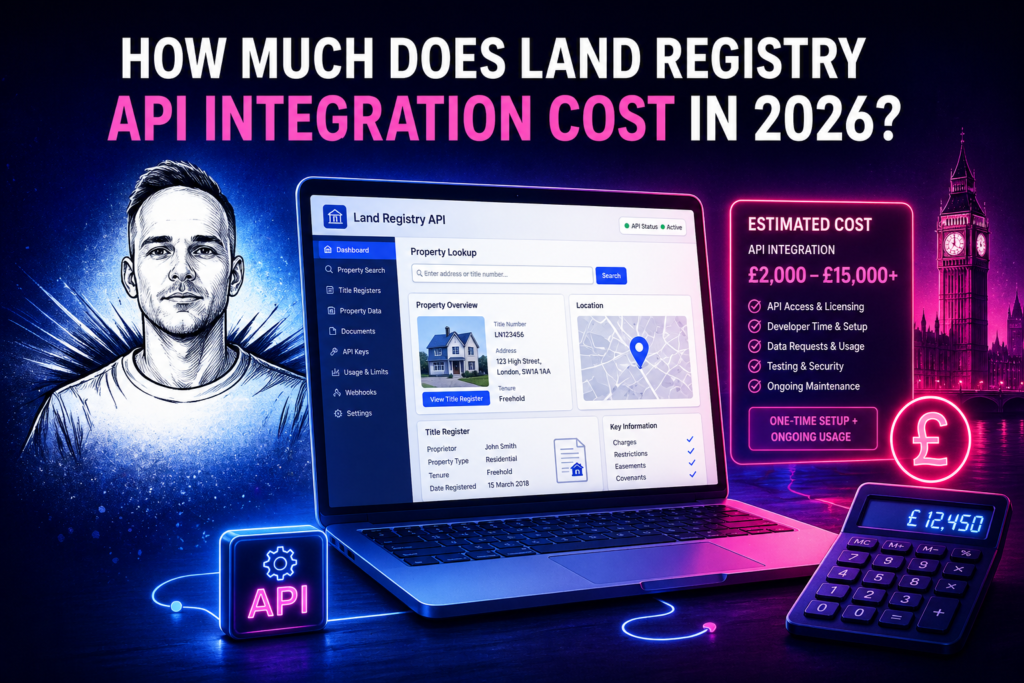
Land Registry API integration isn’t one thing — it’s three meaningfully different products with different access requirements, different costs and different use cases. The price for a Price Paid lookup tool starts around £1,295. A full Business Gateway integration for a conveyancing platform runs to £2,500 or more. Understanding which one you actually need is the first step to getting an accurate quote.
This post breaks down what each option costs, what drives the price up or down, and what a fixed-price quote should cover.
The three tiers of Land Registry integration
Price Paid data lookup: £1,000–£1,500
Price Paid data is HM Land Registry’s open dataset covering every residential property sale in England and Wales since 1995. It’s free to access — no registration, no per-search fees. The integration cost is purely for the development work: building the query layer, mapping the response to your platform, and handling errors for addresses with no transaction history.
What you get: sale price, date, property type (detached, semi, terraced, flat), whether it was a new build, and tenure (freehold or leasehold) for any address or postcode. Updated monthly by Land Registry.
Who needs this: estate agents wanting to show sold prices on listings, mortgage brokers building comparable evidence tools, PropTech platforms that need transaction history without paying for a third-party data provider, and any business that currently pays Rightmove or Zoopla for sold price data and would rather access it directly.
Business Gateway integration: £2,000–£3,000
Business Gateway is the professional API — title register access, ownership verification, charge searches, official copies and title plan retrieval. Unlike Price Paid data, it is not free. Business Gateway charges per search, with costs that vary by product (title register official copies are currently £3 per title). And unlike Price Paid data, access requires registration as a Business Gateway customer.
Business Gateway is available to conveyancers, solicitors, lenders, mortgage brokers and property professionals operating within regulated frameworks. The registration process is via HM Land Registry’s Business e-services portal. Most firms in these sectors already have an account — the integration build assumes you do.
What the integration covers at this tier: authentication and credential management, title register lookup and ownership verification, registered charges and restrictions retrieval, official copy ordering and document filing, caching to avoid unnecessary repeat searches and per-search costs, and an auditable lookup log with timestamps. Testing across property types — leasehold, freehold, unregistered, new build — and full documentation on handover.
Full property data suite: £3,500–£4,500
Everything in the Business Gateway integration, plus Price Paid transaction history, title plan retrieval, and a monitoring layer that watches specified properties for changes. When a new charge is registered, an ownership transfer occurs, or a restriction is added — the system flags it without anyone manually checking.
Who needs this: portfolio managers monitoring large property holdings, lenders with ongoing obligations around secured assets, and platforms that need comprehensive property data automation rather than one-off lookups.
What drives the cost up
Complex case management systems. The Land Registry API side of a Business Gateway integration is well-documented and builds quickly. The time and cost is often in understanding and connecting to the case management system on the other side — especially if it’s a legacy platform with limited API documentation, restricted database access, or non-standard workflow triggers.
Multiple trigger points. A standard integration connects one trigger — instruction received — to one lookup. If you need lookups triggered from multiple points in the workflow, or if different data is needed at different stages, that’s additional scope.
Monitoring across large portfolios. A monitoring layer that checks ten properties is simple. One that checks ten thousand on a schedule, handles rate limits, manages costs and delivers alerts reliably is more complex. The cost scales with the size of the watch list and the frequency of checks required.
Data transformation requirements. Land Registry returns data in a specific format. If your case management system expects data in a different structure — field name mappings, date format conversions, address normalisation — that transformation logic adds time.
What drives the cost down
Clean, well-documented platforms. Integration with a case management system that has a proper REST API and clear documentation is faster than working with a legacy system. If you’re using a modern platform — Osprey, Leap, or a well-built bespoke system — scoping and build are both faster.
Existing Business Gateway access. If your Business Gateway account is set up, API access is enabled, and your credentials are ready, there’s no setup overhead before the build can start.
Narrow, well-defined scope. The clearest briefs produce the fastest quotes and the tightest prices. If you know exactly which data you need, what triggers the lookup, and where the response goes in your system — the build is straightforward.
The per-search cost consideration
Business Gateway per-search fees are separate from and additional to the build cost. They’re charged directly by HM Land Registry to your account. A title register official copy costs £3 per title. Other products vary.
A well-built integration manages these costs by caching responses where appropriate — if the same title is looked up twice in quick succession, the cached result is served rather than a second API call made. For high-volume platforms, the design of the caching layer has a direct impact on your ongoing Land Registry charges.
It’s worth modelling your expected monthly search volume before scoping the build. For a conveyancing firm handling 50 completions per month, the per-search cost is manageable. For a platform running thousands of automated lookups daily, it becomes a significant operational cost that should be factored into the business case.
Compared to manual portal searches
A conveyancer manually searching the Land Registry portal spends 5–10 minutes per title lookup. At scale, this is a significant overhead. The integration cost pays for itself in staff time within months for most firms handling volume.
The less obvious saving is consistency. Manual lookups get done when someone remembers to do them. An automated integration does them every time, at the right point in the workflow, with the result filed in the right place.
For fixed pricing on a Land Registry integration, see the Land Registry API integration service page. You can also try the live Price Paid demo tool to see what the data layer returns before committing to a build. For context on how this compares to other API integration costs, the Companies House API integration cost post covers the same ground for a related integration that many property firms also need.
Related posts
Need a custom integration built?
I build custom API integrations — Stripe, Companies House and bespoke data pipelines. Reliable, well-documented, no agency overhead.
Discuss your project →