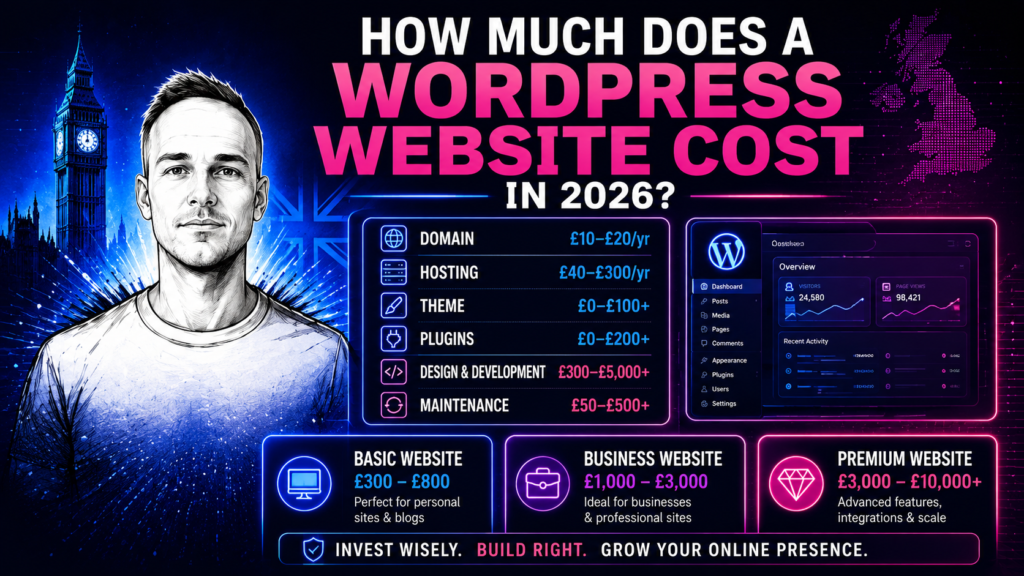
It is one of the most searched questions in web design, and the answer is frustratingly broad: a WordPress website can cost anywhere from a few hundred pounds to tens of thousands. That range is not helpful to anyone trying to budget for a real project.
This guide breaks down what WordPress websites actually cost in the UK in 2026, based on the type of site, the features involved, and whether you build it yourself or hire a developer. No vague ranges — specific numbers for specific situations.
The Short Answer
For a small business in the UK hiring a freelance web designer, expect to pay roughly:
Simple brochure website (3–5 pages): £199–£800. This covers a homepage, about page, services page, contact page, and basic SEO setup. Suitable for tradespeople, consultants, and small local businesses that need a professional web presence without complexity.
Standard business website (5–15 pages): £800–£2,500. Multiple service pages, a blog, contact forms, Google Maps integration, and more detailed content. Suitable for established small businesses, professional services firms, and companies targeting multiple locations or services.
Ecommerce website (WooCommerce): £1,000–£5,000+. Product listings, payment processing, shipping integration, customer accounts. The cost scales with the number of products, payment gateways, and complexity of the checkout process.
Custom or complex builds: £5,000–£20,000+. Custom functionality, API integrations, membership systems, booking engines, multi-vendor marketplaces. These are bespoke development projects where the cost depends entirely on scope.
For full pricing on my own services, see the website pricing page.
What Affects the Price
The difference between a £300 website and a £3,000 website is not random. Several factors drive the cost, and understanding them helps you compare quotes properly.
Number of pages. More pages means more content, more design work, and more time. A 5-page brochure site takes a fraction of the time that a 20-page site with multiple service pages and a blog requires.
Custom design vs templates. A website built on a premium theme or template is significantly cheaper than one with a fully custom design. Custom design means wireframing, mockups, revisions, and bespoke CSS — all of which add time and cost. For most small businesses, a well-configured premium theme delivers excellent results at a fraction of the custom design price.
Content creation. Some developers include copywriting in their price. Others expect you to provide all the text. If you need content written for you, expect to add £50–£150 per page for professional copywriting. Good content is not optional — it directly affects how the site ranks on Google and whether visitors become customers.
Ecommerce functionality. Adding WooCommerce to a WordPress site introduces payment gateway setup, product listings, shipping calculations, tax configuration, and order management. Each of these adds complexity and cost. A simple store with 20 products is very different from a store with 2,000 products, variable pricing, and multiple shipping zones.
SEO setup. Basic SEO — page titles, meta descriptions, image alt text, sitemap submission — should be included in any professional build. More comprehensive SEO work — keyword research, content strategy, Google Business Profile setup, schema markup — is typically a separate service. See SEO services for details.
Integrations. Connecting WordPress to external tools — CRM systems, email marketing platforms, booking systems, payment processors, APIs — adds development time. Simple plugin-based integrations cost less than custom API work. See API integration pricing for the more complex end.
Ongoing Costs After Launch
The build cost is not the only expense. Every WordPress website has recurring costs that you need to budget for:
Domain name: £10–£15 per year for a .co.uk or .com domain. This is the annual registration fee to keep your web address active.
Hosting: £30–£120 per year for shared hosting suitable for most small business sites. Managed WordPress hosting with better performance and support costs £100–£300 per year. High-traffic or ecommerce sites may need VPS or dedicated hosting at £300–£1,200 per year.
SSL certificate: Usually free with modern hosting providers. If not included, expect £50–£100 per year. An SSL certificate is essential — without it, browsers will show security warnings to your visitors.
Plugin licences: Many premium plugins charge annual renewal fees. Common examples include premium themes (£40–£80/year), form builders (£40–£60/year), SEO plugins (£80–£100/year for premium), and security plugins (£60–£100/year). Budget £100–£300 per year for plugin renewals on a typical small business site.
Maintenance and updates: WordPress core, themes, and plugins need regular updates. If you are comfortable doing this yourself, the cost is zero. If you want someone to handle it, monthly maintenance plans typically cost £29–£99 per month depending on what is included — updates, backups, security monitoring, and minor changes.
DIY vs Hiring a Developer
Building a WordPress website yourself is possible and can save significant money. WordPress is free, hosting costs £30–£120 per year, and there are thousands of free themes and plugins. The total out-of-pocket cost for a DIY site can be under £100.
The trade-off is time, quality, and opportunity cost. A professional developer brings experience with design, SEO, performance, security, and user experience. A DIY site may look acceptable but often has issues that only become apparent later — slow load times, poor mobile layout, missing SEO fundamentals, security vulnerabilities, or a design that does not convert visitors into enquiries.
For a business that depends on its website for leads and revenue, hiring a developer is almost always worth the investment. For a personal blog or hobby project, DIY can work perfectly well.
Freelancer vs Agency
Freelance web designers typically charge £200–£3,000 for a small business WordPress site. Agencies typically charge £3,000–£15,000+ for the same scope of work. The difference is largely overhead — agencies have offices, project managers, account managers, and multiple team members involved.
For most small businesses, a freelancer offers better value. You work directly with the person building your site, communication is simpler, and the cost reflects the actual work rather than agency overheads. For larger projects with complex requirements, multiple stakeholders, and ongoing needs, an agency may be more appropriate.
WordPress vs Other Platforms
WordPress is not the only option. Shopify, Squarespace, Wix, and other platforms all serve different needs. Here is how costs compare:
Shopify: £25–£300 per month subscription plus transaction fees. Good for ecommerce, more expensive than WordPress for non-ecommerce sites. Less flexible for custom functionality but easier to manage without technical knowledge.
Squarespace: £12–£35 per month. Good for simple, visually-driven sites. Limited customisation compared to WordPress. Not ideal for sites that need to grow significantly or integrate with external systems.
Wix: £12–£26 per month. Easy to use, limited flexibility. SEO capabilities have improved but still lag behind WordPress. Suitable for very simple sites but can become limiting as the business grows.
WordPress remains the most flexible, cost-effective, and SEO-friendly platform for most small business websites. It powers over 40% of all websites globally for good reason — it scales from a simple brochure site to a complex ecommerce platform without requiring a platform change.
How to Get the Best Value
If you are looking to get a WordPress website built without overspending, these tips will help:
Start with what you need, not what you might need later. A 5-page site that launches quickly and starts generating enquiries is better than a 20-page site that takes three months to complete. You can always add pages and features later.
Prepare your content before the build starts. The biggest cause of delays and cost overruns in web projects is waiting for content. If you can provide text, images, and your logo before development begins, the project will run faster and cost less.
Ask what is included in the quote. Some developers include hosting setup, SEO, and a round of revisions. Others charge extra for each. A higher quote that includes everything can be better value than a lower quote with add-ons.
Check their previous work. Look at websites the developer has actually built — not template demos. Check how those sites look on mobile, how fast they load, and whether they rank on Google for their target keywords.
Frequently Asked Questions
How much does a basic WordPress website cost?
A basic WordPress website for a small business typically costs between £199 and £800 for a simple brochure site with 3–5 pages. This covers design, development, mobile responsiveness and basic SEO setup.
How much does a WordPress ecommerce website cost?
A WordPress ecommerce website using WooCommerce typically costs between £1,000 and £5,000 depending on the number of products, payment integrations and shipping requirements. Complex stores with custom functionality can cost more.
Are there ongoing costs for a WordPress website?
Yes. Budget for domain renewal (£10–15/year), hosting (£30–£120/year), SSL certificate (usually free), plugin licences (£100–£300/year), and optional maintenance plans (£29–£99/month).
Is WordPress cheaper than Shopify?
WordPress typically has lower ongoing costs because there are no monthly platform fees. Shopify includes hosting and security in its subscription. For non-ecommerce sites, WordPress is significantly cheaper. For ecommerce, total costs are often similar but WordPress offers more flexibility.
Can I build a WordPress website myself for free?
WordPress itself is free, but you still need hosting and a domain. Free themes exist but a professional business website usually requires either premium tools or a developer. DIY saves money but takes significant time and the result may not perform as well for SEO or conversions.
If you would like a clear quote for a WordPress website, see my pricing page or get in touch to discuss your project.
Need this done properly?
I work directly with small businesses on web design, WordPress fixes, Shopify support and local SEO. No agency overhead.
See web design in Blackburn →