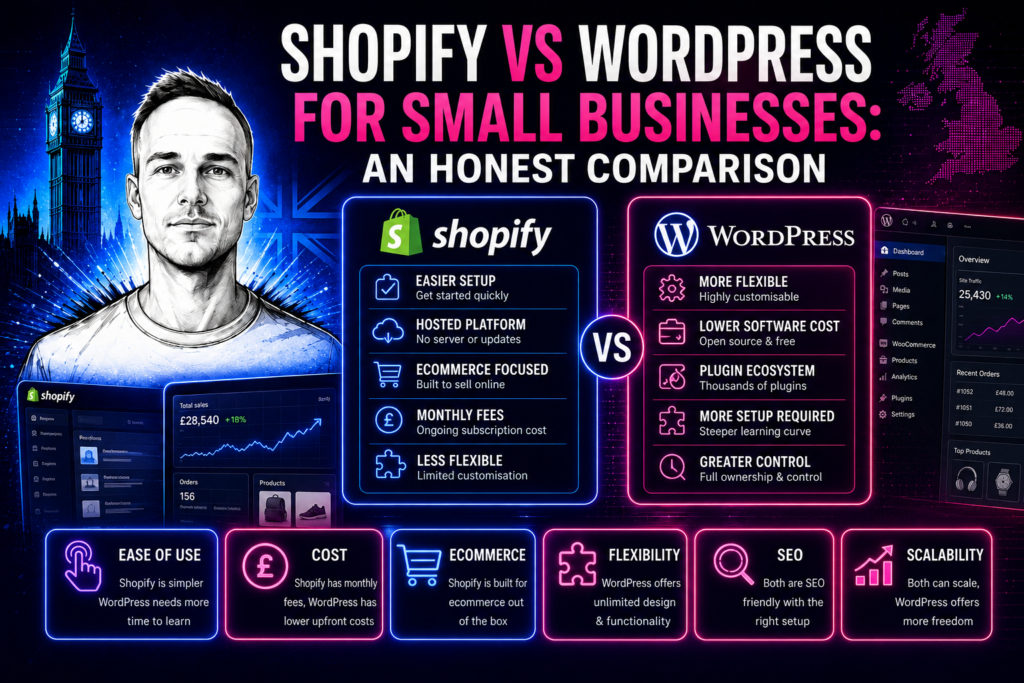
Shopify or WordPress? It is one of the most common questions small business owners ask when they are getting a website built, and the honest answer is that neither platform is universally better — they solve different problems.
This guide compares the two platforms across the things that actually matter to small businesses: cost, ease of use, flexibility, SEO, ecommerce capability, and long-term scalability. No affiliate links, no bias — just an honest breakdown from someone who builds on both platforms.
The Quick Answer
Choose Shopify if: your business is primarily about selling physical products online, you want the simplest possible setup, you do not need a blog or content-heavy pages, and you are happy paying a monthly subscription for a managed platform.
Choose WordPress if: your business is service-based, you need a blog or content strategy, you want full control over design and functionality, you need custom integrations, or you want to keep ongoing costs low.
If your business does both — services and products — WordPress with WooCommerce usually offers more flexibility than Shopify for non-ecommerce content.
Cost Comparison
This is where the two platforms differ most significantly for small businesses.
Shopify costs: The Basic plan starts at £25 per month (billed annually). The standard Shopify plan is £65 per month. On top of this, Shopify charges transaction fees of 0.5%–2% on every sale unless you use Shopify Payments. Apps — Shopify’s equivalent of plugins — often carry their own monthly fees, and these add up quickly. A typical small Shopify store might pay £40–£100 per month in total platform costs before any development work.
WordPress costs: WordPress itself is free. Hosting costs £30–£120 per year for shared hosting. A domain costs £10–£15 per year. Premium themes and plugins might add £100–£300 per year. Total annual running cost for a typical small business WordPress site: £150–£400. That is significantly less than Shopify’s £300–£1,200 per year in subscription fees alone.
The build cost — what you pay a developer — is similar for both platforms. A professional Shopify store costs roughly the same as a WordPress site of equivalent complexity. The ongoing cost difference is where WordPress saves money.
For a detailed breakdown, see how much a WordPress website costs or my full pricing page.
Ease of Use
Shopify is easier to get started with. It is a managed platform — you sign up, choose a theme, add products, and you are live. Hosting, security, SSL, and software updates are all handled for you. The admin interface is clean and focused on ecommerce tasks.
WordPress requires more initial setup. You need to choose a hosting provider, install WordPress, select and configure a theme, and install plugins for the features you need. Once set up, the day-to-day editing experience is straightforward — adding pages, writing blog posts, and updating content is simple. But the initial setup is undeniably more involved than Shopify.
For ongoing maintenance, WordPress requires regular updates to core software, themes, and plugins. This is not difficult but it is something you need to either do yourself or pay someone to handle. Shopify handles all platform maintenance automatically.
Ecommerce Capability
Shopify was built for ecommerce. Payment processing, inventory management, shipping calculations, tax handling, and order management are all built into the core platform. Setting up a store is fast, and the checkout experience is polished and optimised for conversions.
WordPress handles ecommerce through WooCommerce, a free plugin that adds store functionality. WooCommerce is extremely capable — it powers roughly 25% of all online stores globally — but it requires more configuration than Shopify. Payment gateways, shipping zones, and tax rules need to be set up individually. The result is more flexible but takes more time to configure.
For straightforward product selling, Shopify gets you live faster. For stores that need custom checkout flows, complex pricing rules, or integration with external systems, WooCommerce’s flexibility is an advantage.
SEO
WordPress has a clear advantage for SEO. With plugins like Yoast SEO, you have full control over page titles, meta descriptions, URL structure, schema markup, XML sitemaps, breadcrumbs, and canonical tags. The blogging functionality is excellent, which matters because content is one of the most effective ways to drive organic traffic.
Shopify’s SEO is adequate but has known limitations. URL structure includes mandatory prefixes (/collections/, /products/, /pages/) that you cannot remove. The blogging functionality is basic compared to WordPress. Schema markup options are limited without third-party apps. These are not deal-breakers for most stores, but for businesses where organic search is a primary growth channel, WordPress provides more tools to work with.
If your business depends heavily on blog content, local SEO, or ranking for informational keywords, WordPress is the stronger choice. If your SEO strategy is focused primarily on product pages and category pages, Shopify is sufficient.
Flexibility and Customisation
WordPress is open-source software with a plugin ecosystem of over 60,000 free plugins and thousands of premium options. You can build virtually anything — membership sites, booking systems, learning platforms, directories, forums, or complex business applications. There are very few limitations on what you can create.
Shopify is a closed platform. You can customise within the boundaries Shopify provides — themes, apps, and the Liquid templating language — but you cannot fundamentally change how the platform works. For ecommerce this is rarely a problem, but for businesses that need non-standard functionality, Shopify can become limiting.
If you need API integrations with external systems like CRMs, accounting software, or custom databases, WordPress offers more freedom. Shopify has good API capabilities too, but the closed nature of the platform means some integrations are harder or impossible to achieve.
Security
Shopify handles security for you. The platform is PCI-DSS compliant, SSL is included, and security patches are applied automatically. You do not need to worry about server-level security.
WordPress requires you to manage security yourself — or pay someone to do it. This means keeping software updated, using strong passwords, installing a security plugin, and choosing a reputable hosting provider. WordPress itself is secure when properly maintained, but neglected sites with outdated plugins are a common target for attacks.
For businesses that do not want to think about security, Shopify’s managed approach is simpler. For businesses willing to invest in proper maintenance, WordPress security is not a significant concern.
When to Use Both
Some businesses use both platforms. A service business might run its main website on WordPress for content and SEO, while using Shopify for a separate online store. This works well when the store and the service business have different audiences or when the ecommerce needs are simple enough to keep separate.
The alternative is WordPress with WooCommerce for everything — one site, one platform, one set of analytics. This is usually simpler to manage and better for SEO because all traffic and authority goes to one domain.
Frequently Asked Questions
Is Shopify or WordPress better for a small business?
It depends on what the business needs. Shopify is better for businesses focused primarily on selling physical products online. WordPress is better for service businesses, content-driven sites, and businesses that need flexibility beyond ecommerce.
Is Shopify easier to use than WordPress?
Yes, for ecommerce. Shopify handles hosting, security, and payment processing out of the box. WordPress requires more initial setup and some technical knowledge for maintenance. For day-to-day content editing, both are straightforward.
Which is better for SEO, Shopify or WordPress?
WordPress offers more SEO flexibility with full control over URL structure, metadata, schema markup, and site architecture. Shopify’s SEO has improved but still has structural limitations that WordPress does not.
Can I switch from Shopify to WordPress later?
Yes, but it involves migrating products, content, and URLs. The process requires careful planning to avoid losing search rankings. It is easier to start on the right platform than to migrate later.
Is WordPress cheaper than Shopify?
WordPress typically has lower ongoing costs — £150–£400 per year compared to Shopify’s £300–£1,200+ per year. Build costs from a developer are similar for both platforms.
If you need help deciding between Shopify and WordPress for your business, or want a quote for either platform, see my pricing page or get in touch.
Need this done properly?
I work directly with small businesses on web design, WordPress fixes, Shopify support and local SEO. No agency overhead.
See web design in Blackburn →