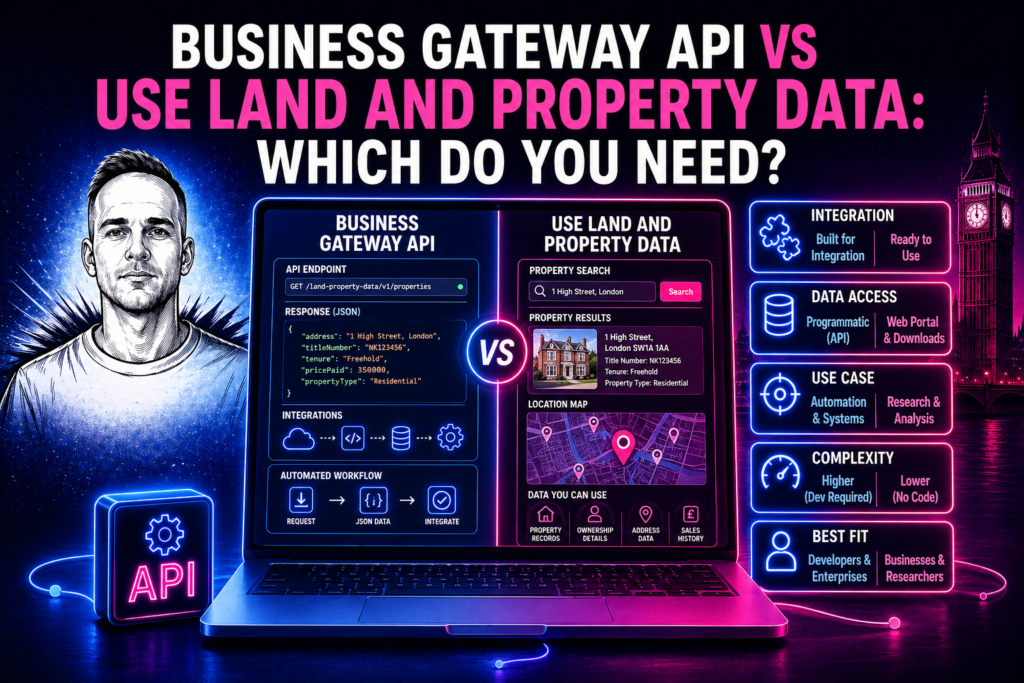
HM Land Registry has two distinct ways to access property data programmatically, and they serve completely different use cases. Conflating them is the most common mistake in scoping a Land Registry integration — leading to wrong assumptions about access requirements, costs, and what data is actually available.
This post explains what each product is, what it returns, who can access it, and which one your project needs.
Business Gateway API
Business Gateway is the professional transactional API. It provides access to the Land Register — the official record of property ownership in England and Wales — and to the services associated with conveyancing transactions.
What it provides: Title register retrieval (ownership, charges, restrictions, easements), official copies of the register and title plan, charge and restriction searches, bankruptcy searches via the Land Charges Register, and — via the Digital Registration Service — submission of applications to change the register.
Who can access it: Regulated professionals operating in the property transaction chain. Conveyancers, solicitors, licensed conveyancers, lenders, mortgage brokers. Access requires registration as a Business Gateway customer via HM Land Registry’s Business e-services portal. It is not available to the general public or to businesses outside the property sector.
What it costs: Per-search fees charged directly by HM Land Registry. Title register official copies are currently £3 per title. Other products have different rates. The API itself has no subscription fee, but every search generates a charge to your account.
Authentication: Basic authentication using Business Gateway credentials, plus a mutual TLS client certificate issued by HM Land Registry. The certificate requirement means the integration cannot be built without your firm’s specific credentials. There’s no way to build or demo a Business Gateway integration using a generic or test account for a public-facing tool.
Use Land and Property Data
Use Land and Property Data is a separate service providing access to HM Land Registry’s bulk open datasets. These are not the live register — they’re derived datasets published on a regular cycle, covering specific categories of property data.
What it provides: Price Paid Data (all residential property sales in England and Wales since 1995), UK companies that own property in England and Wales (CCOD), overseas companies that own property (OCOD), and the National Polygon Service (property boundary data). Each dataset is updated on a monthly or quarterly cycle — they are not real-time.
Who can access it: Anyone. Registration is free via the service website. Most datasets are free of charge. No professional registration is required.
What it costs: Most datasets are free. The National Polygon Service has a commercial licence fee.
Authentication: API key passed as a header. Simple to implement, no client certificate required.
Price Paid Data specifically
Price Paid Data sits slightly apart from the Use Land and Property Data service — it’s also accessible via a SPARQL endpoint at landregistry.data.gov.uk. This endpoint is queryable without any authentication at all, making it the most accessible Land Registry data source available.
A SPARQL query against the Price Paid endpoint can return all transactions for a specific address, all transactions in a postcode, or all transactions for a property type in a given area within a date range. This is the data that powers sold price tools on estate agent websites, property portals and mortgage broker platforms. It’s free, it’s real-time queryable, and it requires no professional access. You can see it working in the live Price Paid demo tool — enter any UK postcode to see recent sales data returned directly from Land Registry.
Which one does your project need?
You need Business Gateway if: you’re a conveyancer, solicitor or lender who needs actual title register data — ownership, charges, restrictions, official copies. If your use case involves verifying who owns a property, checking what’s registered against a title, or submitting applications to change the register, Business Gateway is the right route.
You need Use Land and Property Data if: you need bulk data about corporate property ownership across England and Wales, or property boundary data at scale.
You need Price Paid Data if: you need sold prices and transaction history for residential properties. Estate agents, mortgage brokers, valuation tools, property portals. Free, open access, no professional registration required.
You might need both if: your platform serves both professional users who need title register access and consumer or analytical use cases where sold price history is useful.
The common mistake
The most common mistake I see in Land Registry integration briefs is assuming that any firm can access title register data via a simple API key. That assumption leads to a scoping conversation that doesn’t account for Business Gateway registration, per-search fees, or the credential management required for a properly secured integration.
If you’re not sure which applies to your use case, describe it in one line and I’ll confirm which route is appropriate before any scoping begins.
For full details on what each product costs to integrate, see the Land Registry API integration cost breakdown. For how Business Gateway specifically applies to conveyancers, see Land Registry API for conveyancers. And for the service page covering all three integration tiers, see the Land Registry API integration service.
Related posts
Need a custom integration built?
I build custom API integrations — Stripe, Companies House and bespoke data pipelines. Reliable, well-documented, no agency overhead.
Discuss your project →