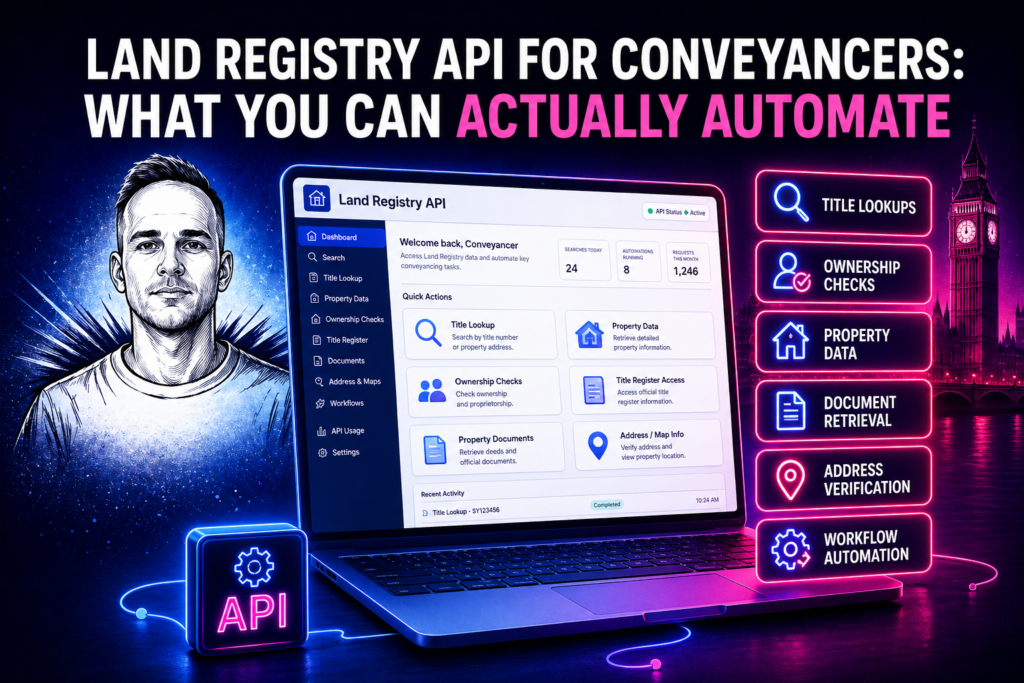
Most conveyancing firms already have Business Gateway access. The portal is used dozens of times a day — title register searches, official copies, charge searches — with someone manually logging in, running the search, downloading the result and filing it against the matter. Every one of those steps can be automated.
This post covers what the Land Registry Business Gateway API actually provides for conveyancers, what’s realistically automatable, and what a connected case management workflow looks like in practice.
What Business Gateway provides for conveyancing
Business Gateway gives programmatic access to the same Land Registry data your team accesses via the portal, delivered as structured data responses rather than downloadable documents. The key capabilities for conveyancing use:
Title register retrieval. Pull the official register of title — ownership, charges, restrictions, easements, covenants — for any registered title in England and Wales. The same data as an official copy, returned as structured data that can be written directly into your case management system.
Ownership verification. Check the registered proprietor against the name of the person instructing you. Useful at the start of a matter to confirm authority to sell or mortgage, and as a check during the transaction if there are concerns about identity.
Charge and restriction searches. Retrieve registered charges (mortgages, legal charges) and restrictions against a title. Automated as part of the conveyancing workflow rather than a manual portal search at each stage.
Official copy ordering. Order official copies of the register and title plan programmatically. The copy is returned as a document that can be filed directly against the matter in your case management system.
Title plan retrieval. Retrieve the title plan image as part of an automated workflow rather than a separate manual download.
Bankruptcy search. The Land Charges Register bankruptcy search, automated as part of pre-completion checks rather than a manual submission.
What the automated workflow looks like
The most common integration point is matter opening. When a new conveyancing matter is created in your case management system, the integration triggers a title register search against the title number supplied. The result is written to the matter record: registered owner, charges, restrictions, registered address. A fee earner reviewing the new matter sees the Land Registry data already in the file, without having to open the portal.
At the pre-contract stage, the integration can automatically order official copies — register and title plan — and file them against the matter. At pre-completion, bankruptcy searches run automatically. At the point of application, the integration submits the registration application via the Digital Registration Service API and monitors for completion.
The result is a conveyancing workflow where Land Registry interactions happen automatically at the right stage, with results filed in the right place, rather than being triggered by someone remembering to run a search.
What case management systems can connect
Most modern conveyancing case management systems have an API or database that allows external data to be written to matter records. The integration sits between Business Gateway and your case management system — receiving the Land Registry response and writing the relevant fields to the right place in the matter.
Osprey, Leap, Redbrick and similar platforms all have integration routes, though they differ in how external data can be written and what triggers can fire an API call. Bespoke and legacy systems vary more widely — some have clean APIs, others require database-level integration or webhook-based triggers.
The scoping conversation for a Land Registry integration always starts with your case management system. Which system you’re on, how data is structured, and what triggers exist in your workflow determines the shape of the integration and the build cost.
What you need in place
An active Business Gateway account. Most conveyancing firms already have one. If not, registration is via the HM Land Registry Business e-services portal. API access specifically may need to be enabled on your account — worth confirming before the build starts.
API credentials. Business Gateway issues API credentials separately from portal access. These take a few days to set up via Land Registry support. Worth initiating early as it’s occasionally a bottleneck.
A decision on trigger points. Which steps in your conveyancing workflow trigger a Land Registry search, and what data is needed at each step. This is the scoping conversation — it doesn’t need to be fully mapped before getting in touch, but having a rough idea of the workflow helps.
The compliance angle
For regulated firms, an automated Land Registry integration has a compliance benefit beyond the time saving. Every lookup is timestamped and logged — what was searched, when, what the result was. For firms subject to CQS, Lexcel or other quality mark requirements, an auditable record of identity and title verification is a requirement, not optional.
Manual portal searches produce this record only if the downloaded copy is correctly named, filed and indexed against the right matter. In practice, this is inconsistently done, especially in high-volume practices. An automated integration produces the record every time, correctly filed, without depending on someone following the right process.
Cost and timescales
A Business Gateway integration for a conveyancing case management system typically takes two weeks from deposit to handover. More complex builds — multiple trigger points, monitoring layers, application submission — take three to four weeks.
For pricing, see the Land Registry API integration service page. The Property Price Checker demo shows the Price Paid data layer in action — useful context for understanding what the public dataset returns alongside the title register data. For the cost breakdown, see how much a Land Registry API integration costs. And if you’re also running company checks as part of commercial conveyancing, the Companies House API integration covers the business entity verification piece.
Related posts
Need a custom integration built?
I build custom API integrations — Stripe, Companies House and bespoke data pipelines. Reliable, well-documented, no agency overhead.
Discuss your project →