WordPress, Shopify, Squarespace, Wix, Webflow — the number of website platforms available in 2026 is overwhelming. Each claims to be the best. Each has advocates and critics. And if you are a small business owner trying to make a decision, the noise makes it harder, not easier.
This guide cuts through it. After 20 years of building websites for businesses, I have worked with all of these platforms. Here is an honest assessment of each one, who it suits, and which I recommend for different types of small business.
The Quick Recommendation
If you want the short answer before the detail:
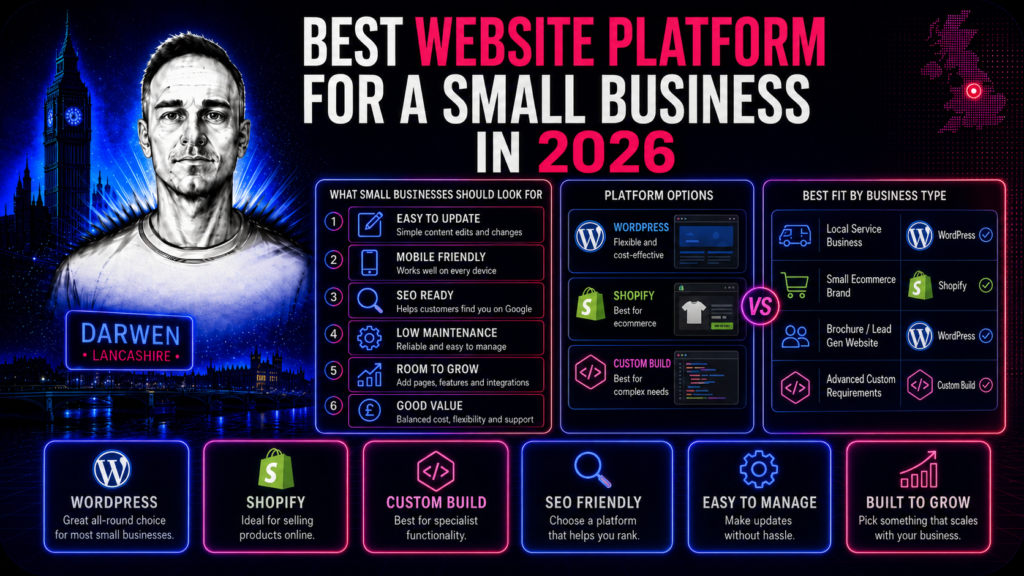
WordPress — best for most small businesses. Service businesses, tradespeople, professional services, content-driven sites, and businesses that need flexibility. Lowest ongoing costs, best SEO, most customisable.
Shopify — best for pure ecommerce. If your business is primarily about selling physical products online and you want the simplest possible store setup, Shopify is purpose-built for this.
Squarespace — best for creatives who need a beautiful portfolio site and do not need advanced functionality. Photographers, designers, artists.
Wix — suitable for very simple sites where the owner wants to build it themselves and does not plan to scale significantly.
For a more detailed comparison of the two most common choices, see Shopify vs WordPress for small businesses.
WordPress
WordPress powers over 40% of all websites globally, from one-page brochure sites to major publications and complex ecommerce stores. It is open-source, meaning the software itself is free, and the ecosystem of themes and plugins is enormous.
Best for: Service businesses, tradespeople, professional services, blogs, content marketing, local businesses targeting SEO, and businesses that may need custom functionality as they grow.
Strengths: Full control over design, layout, and functionality. The best SEO tools of any platform (Yoast SEO, Rank Math). No monthly platform fee — you only pay for hosting. Thousands of free and premium plugins for forms, booking systems, membership areas, and more. You own the site completely and can move it to any hosting provider.
Weaknesses: Requires separate hosting. Initial setup is more involved than managed platforms. Needs regular updates to core software, themes, and plugins. Security is your responsibility (though this is straightforward with a good host and basic maintenance).
Typical cost: £30–£120/year for hosting, £10–£15/year for domain, £100–£300/year for premium plugins. Build cost with a developer: £199–£5,000+ depending on complexity. See full WordPress cost breakdown.
Shopify
Shopify is a dedicated ecommerce platform. Everything is built around selling products online — product listings, inventory, payments, shipping, and order management are all part of the core platform.
Best for: Businesses that primarily sell physical products online. Particularly good for businesses that want a managed solution where hosting, security, and updates are handled automatically.
Strengths: Excellent checkout experience. Built-in payment processing. Handles hosting, security, and SSL automatically. App ecosystem for extending functionality. Easy to manage without technical knowledge.
Weaknesses: Monthly subscription fees (£25–£300/month). Transaction fees unless using Shopify Payments. Limited control over URL structure (mandatory /products/, /collections/ prefixes). Basic blogging tools compared to WordPress. Less flexible for non-ecommerce content. You do not own the platform — if Shopify changes its terms or pricing, you have limited options.
Typical cost: £25–£65/month subscription plus transaction fees. Build cost with a developer: £500–£5,000+.
Squarespace
Squarespace is a managed website builder known for elegant, design-forward templates. It is particularly popular with creatives — photographers, designers, artists, and small lifestyle brands.
Best for: Portfolios, creative businesses, and simple brochure sites where visual design is the priority and functionality requirements are basic.
Strengths: Beautiful templates out of the box. Managed hosting and security. Simple drag-and-drop editor. Good image handling for portfolios.
Weaknesses: Limited customisation beyond template options. SEO tools are adequate but less comprehensive than WordPress. Ecommerce features are basic compared to Shopify. Plugin/extension ecosystem is much smaller than WordPress or Shopify. Monthly fees with no option to self-host. Can feel limiting as the business grows.
Typical cost: £12–£35/month subscription. Build cost if hiring a designer: £300–£2,000.
Wix
Wix is a drag-and-drop website builder aimed at people who want to build their own site without any technical knowledge. It is the easiest platform to get started with.
Best for: Very simple sites built by the business owner themselves. Hobby businesses, personal projects, and businesses with minimal online requirements.
Strengths: Easiest to use — genuinely drag and drop. Free plan available (with ads). AI site builder for quick setup. Managed hosting.
Weaknesses: SEO capabilities are weaker than WordPress, particularly for local SEO and technical optimisation. Sites tend to be slower than WordPress equivalents. Cannot migrate to another platform — if you outgrow Wix, you rebuild from scratch. Limited app ecosystem. Professional-looking results require more effort than the marketing suggests. Monthly fees required for removing ads and using a custom domain.
Typical cost: £12–£26/month subscription. Many businesses build their own, so no developer cost — but the time investment is significant.
Webflow
Webflow is a visual web design tool aimed at designers and developers. It produces clean, fast websites with significant design flexibility.
Best for: Design agencies, tech companies, and businesses that want pixel-perfect design with good performance. Not suitable for non-technical business owners building their own site.
Strengths: Excellent design flexibility. Clean code output. Good performance. Strong animations and interactions.
Weaknesses: Steep learning curve. Not suitable for DIY by non-designers. Monthly hosting fees. Smaller ecosystem than WordPress. Ecommerce features are limited. CMS functionality is less mature than WordPress.
Typical cost: £15–£40/month hosting. Build cost with a Webflow developer: £1,000–£10,000+.
How to Choose
The decision should be based on what your business actually needs, not which platform has the best marketing:
If SEO matters to your business — and for most small businesses it should — WordPress is the clear winner. No other platform offers the same level of control over the elements that affect search rankings.
If you are building an online store and nothing else — Shopify gets you live faster with less technical overhead. But if your store also needs a blog, service pages, or content marketing, WordPress with WooCommerce is more flexible.
If budget is the primary concern — WordPress has the lowest ongoing costs. No monthly platform fee means you are only paying for hosting and domain — typically £50–£130 per year total.
If you want to build it yourself with zero technical knowledge — Wix or Squarespace are easier to start with, but be aware that you may outgrow them. A professionally built WordPress site costs from £199 and will serve you far longer.
Frequently Asked Questions
What is the best website platform for a small business in the UK?
WordPress is the best all-round platform for most UK small businesses. It offers the most flexibility, best SEO tools, lowest ongoing costs, and scales from a simple brochure site to a full ecommerce store.
Is WordPress hard to use?
Day-to-day editing is straightforward. The initial setup requires more technical knowledge, which is why most businesses hire a developer for the build and manage content themselves afterwards.
Is Wix good for a small business website?
Wix works for very simple sites but has significant limitations. SEO tools are weaker, customisation is limited, and you cannot migrate to another platform later. Most businesses outgrow it.
Which website platform is cheapest?
WordPress has the lowest ongoing costs — no monthly platform fee, just hosting (£30–120/year) and domain (£10–15/year). All other platforms charge monthly subscriptions.
If you want help choosing the right platform or need a website built, see pricing or get in touch.
Need this done properly?
I work directly with small businesses on web design, WordPress fixes, Shopify support and local SEO. No agency overhead.
See web design in Blackburn →