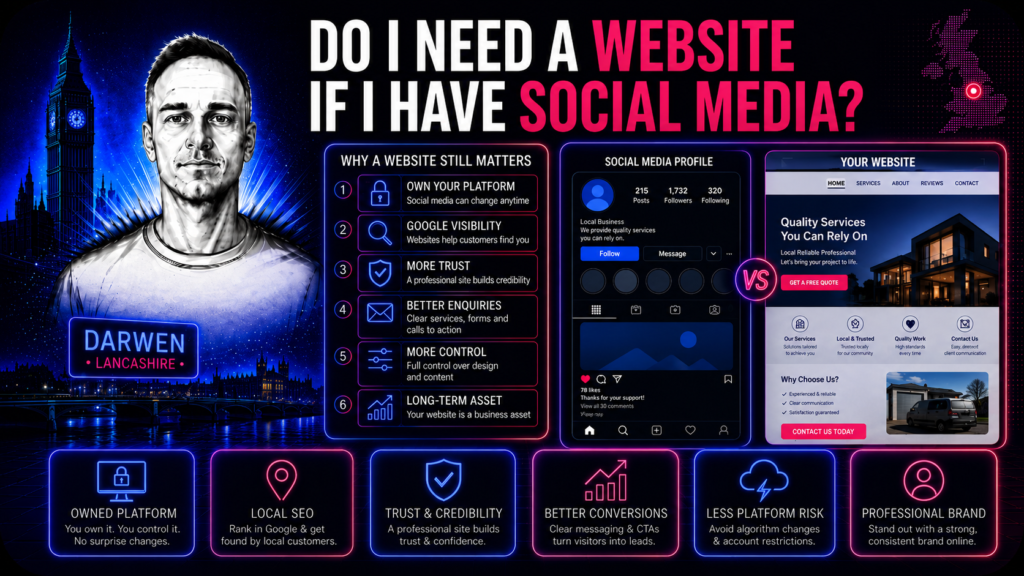
It is one of the most common questions small business owners ask, and it usually comes from a reasonable place: “I already have a Facebook page, I get enquiries through Instagram, I am listed on Google Maps — why would I spend money on a website?”
The short answer is that social media and a website do different jobs. Social media is good for engagement, brand awareness, and staying visible to people who already know you exist. A website is good for being found by people who do not know you exist yet — and that is where growth comes from.
This post explains the practical differences, when social media is enough, and when a website becomes essential.
What Social Media Does Well
Social media is not useless. For small businesses, it has genuine strengths:
Staying top of mind. Regular posts keep your business visible to people who follow you. A tradesperson posting photos of completed jobs reminds past customers they exist and prompts referrals. A restaurant sharing daily specials keeps regulars engaged.
Social proof. Reviews, comments, shares, and engagement signal to potential customers that the business is active, trusted, and real. A Facebook page with 200 reviews and regular activity builds confidence.
Direct communication. Facebook Messenger, Instagram DMs, and WhatsApp give customers a quick way to ask questions and get responses. For some businesses, this is their primary enquiry channel.
Community building. Local businesses can join and contribute to community groups, share local content, and build a reputation within a geographic area.
What Social Media Cannot Do
Despite its strengths, social media has fundamental limitations that a website does not:
You do not own it. Your Facebook page, your Instagram account, your TikTok profile — none of these belong to you. The platform owns them. They can change the rules, reduce your visibility, or shut your account with no warning and no appeal. Businesses have lost years of content and thousands of followers overnight because of algorithm changes or account suspensions. A website is your property. Nobody can take it away.
It does not rank on Google. When someone searches “plumber in Blackburn” or “best restaurant near me,” Google does not show Facebook posts. It shows websites and Google Business Profiles. If you do not have a website, you are invisible to everyone who searches for your services on Google — and that is where the highest-intent customers are.
Content disappears. A social media post has a lifespan of hours. An Instagram story lasts 24 hours. A tweet is buried within minutes. A blog post on a website can rank on Google for years, bringing in traffic long after it was published. The effort you put into social media content evaporates. The effort you put into website content compounds.
Limited information architecture. A Facebook page gives you a cover photo, an about section, and a feed. You cannot create separate service pages, detailed pricing information, a blog, a portfolio, or a booking system. You cannot structure content in a way that helps Google understand what your business does. A website gives you unlimited space to present your business professionally and comprehensively.
No control over design or branding. Your social media page looks like every other social media page. The platform controls the layout, the colours, the fonts, and where your content appears. A website reflects your brand — your colours, your design, your layout, your messaging. It is your shopfront on the internet.
The Google Problem
This is the critical issue. Google is where people go when they are ready to buy. Someone scrolling Facebook might see your post and think “that looks nice” — but someone searching “electrician near me” is actively looking to hire someone right now.
Google search traffic is the highest-converting traffic available to a small business. These are people who have identified a need, typed it into Google, and are looking at the results to decide who to call. If your business does not appear in those results, that customer goes to a competitor who does.
A Google Business Profile helps — it can get you into the map pack for some searches. But the organic results below the map are dominated by websites. Without a website, you are relying entirely on the map pack, which only shows three businesses. With a website, you can rank in both the map results and the organic results, doubling your visibility.
When Social Media Alone Is Enough
There are a small number of situations where social media alone might be sufficient:
Hobby businesses and side projects. If you are selling handmade crafts at local markets and not looking to scale, a Facebook page or Etsy shop may be all you need.
Businesses that are already at capacity. If you have more work than you can handle and genuinely do not want more customers, a website is not necessary. But this situation rarely lasts — customers leave, markets change, and the businesses that invested in their online presence during good times are the ones that survive the bad times.
For virtually every other small business, a website is a better investment than more social media effort.
The Best Approach: Both, Working Together
Social media and a website are not either/or. The most effective approach is to use them together:
Your website is the hub. It contains your service information, pricing, portfolio, blog posts, and contact details. It ranks on Google and brings in new customers who have never heard of you.
Social media points to the hub. Every post, every bio, every profile links back to your website. Social media drives awareness and engagement; the website converts that attention into enquiries and sales.
Blog posts on your website give you content to share on social media — each new post is a reason to post on Facebook, LinkedIn, or Instagram. This creates a virtuous cycle: the blog content ranks on Google bringing in search traffic, and the social shares drive additional visits and engagement.
What a Simple Business Website Costs
A professional website does not have to be expensive. A clean, mobile-friendly brochure site with 3–5 pages starts from £199. That is less than most businesses spend on a single month of boosted Facebook posts — and the website continues working for years.
For full pricing, see the pricing page or how much a WordPress website costs.
Frequently Asked Questions
Can social media replace a website for a small business?
No. Social media is useful for engagement and brand awareness, but it cannot replace a website for Google search visibility, credibility, or control. You do not own your social media presence — the platform does. A website is your own property on the internet.
Do I need a website if I get all my work from Facebook?
If all your work comes from Facebook today, a website opens an entirely new channel — Google search. People searching for your services on Google are high-intent customers ready to buy. Without a website, you are invisible to all of them.
Is a website worth it for a one-person business?
Yes. A simple 3–5 page website from £199 gives you a professional online presence, makes you findable on Google, and works around the clock. For a sole trader, it is one of the highest-return investments available.
What should I do first — website or social media?
Website first. It is the foundation that everything else points to. Social media profiles should link to your website, not the other way around. A website ranks on Google permanently; social media posts disappear within hours.
If you need a simple, affordable website for your business, I can help. See pricing or get in touch.
Need this done properly?
I work directly with small businesses on web design, WordPress fixes, Shopify support and local SEO. No agency overhead.
See web design in Blackburn →