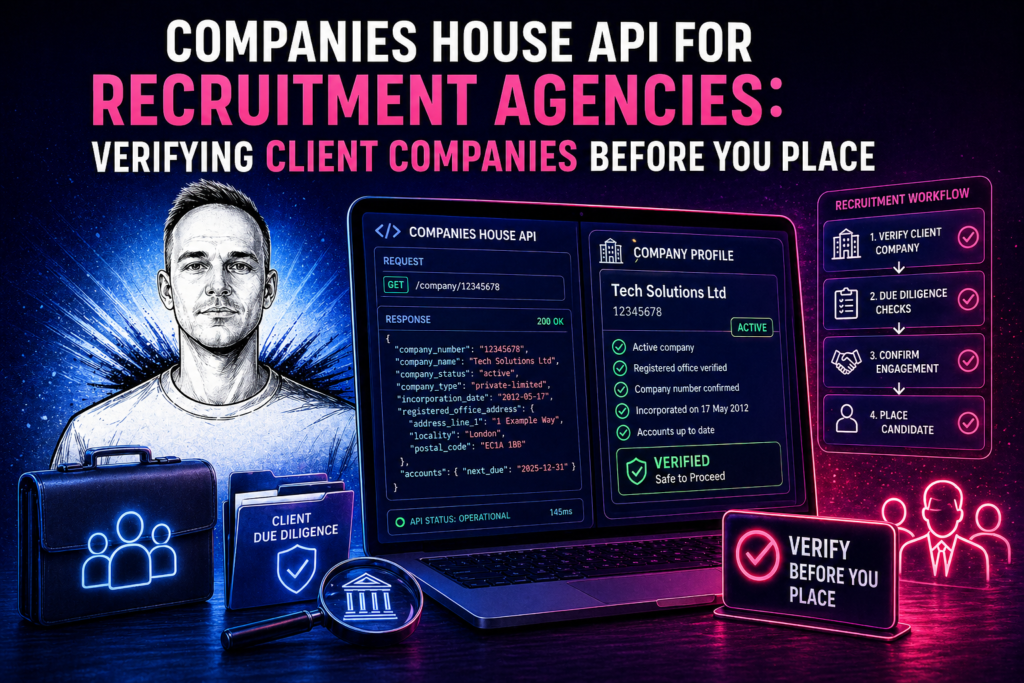
Every recruitment agency I’ve spoken to has a version of the same story. A consultant opens a new client account, does a quick Google, maybe glances at the company website, and sends candidates. The company looks legitimate. The invoices go unpaid. Three months later, a Companies House search reveals the company was in compulsory strike-off proceedings before the first placement went ahead.
The information was publicly available. Nobody checked it systematically. The consultant didn’t have time, or didn’t think to, or trusted their instincts over the register. This is the gap the Companies House API closes — not by adding a new step, but by making the check automatic.
Why manual Companies House checks don’t scale
Most agencies have some version of a client verification process. In practice it often looks like this: a consultant or credit controller searches Companies House manually, screenshots or notes the result, and either files it somewhere or makes a judgment call based on what they saw. Then the next client account opens and the same process happens, or doesn’t, depending on who’s handling it and how busy they are.
The problem isn’t that people don’t know the check matters. It’s that manual processes are inconsistently applied, especially under the time pressure of competitive recruitment where a client wants candidates yesterday. An automated integration removes the discretion entirely. Every new client account gets checked, every time, without anyone having to remember to do it.
What the Companies House API actually checks
When you submit a company registration number to the API, it returns the live record from the official UK register. For a recruitment agency’s purposes, the most relevant data is:
Company status. Active, dissolved, in liquidation, in administration, in receivership, subject to voluntary arrangement, or dormant. If the status is anything other than active, that’s a flag that needs to go in front of someone before a placement proceeds.
Incorporation date. A company incorporated last month asking for 30-day payment terms on a senior placement is worth a second look.
Registered address. Does it match what the client told you? Discrepancies between the registered address and the trading address aren’t automatically suspicious, but they’re worth knowing about.
Officers and directors. Current directors, their appointment dates, and — where available — their other directorships. A client contact who isn’t listed as a director of the company they claim to represent is worth querying. A company where all directors resigned three months ago is a different kind of problem.
Confirmation statement and accounts status. Companies that are overdue on their confirmation statement or accounts filings are either disorganised or in difficulty. Either way, relevant context before extending credit.
PSC data. Persons with significant control — who ultimately owns and controls the company. Relevant for larger clients or where the placement involves access to sensitive information or systems.
How the integration works in practice
The typical integration point for a recruitment agency is the new client account creation in your CRM or back-office system. The workflow looks like this:
A consultant creates a new client record. As part of that record, they enter the client’s company registration number — or the system looks it up automatically from the company name. The Companies House API is called in the background. The response is checked against a set of rules: is the company active? Are accounts overdue? Is there an insolvency flag? The results are written to the client record and surfaced to whoever handles credit decisions.
If the company is active with no flags, the check is logged and the process continues. If there’s a flag — dissolved status, overdue accounts, an insolvency case — the record is held for review before credit terms are agreed.
None of this requires a consultant to do anything differently. They enter the company number as part of normal account setup. The check happens automatically.
Recruitment CRM systems and where the integration sits
The most common CRM platforms in recruitment — Bullhorn, Vincere, Recruit CRM, Mercury — all have API access that allows you to read and write to client records. The Companies House integration sits between the two: a new client record in your CRM triggers a lookup, and the result is written back to that record as a set of verified fields.
Some agencies prefer a slightly different approach: a standalone internal tool that credit controllers use to run checks before approving a new account, rather than an automated trigger. Both work. The automated trigger is more comprehensive because it catches every account. The standalone tool gives the credit team more control over the process.
What doesn’t work well is a third-party dashboard that your team has to remember to log into. That’s just a faster version of the manual process — it still depends on someone choosing to use it.
Credit decisions and Companies House data
Companies House data is not a credit report. It doesn’t tell you about county court judgments, payment history, or credit scores. What it tells you is whether the company legally exists, whether it’s trading, who runs it, and whether it’s keeping up with its statutory obligations.
That’s a different and complementary layer of information. An agency using both a credit reference agency and a Companies House integration gets verification that the company exists and is legitimate (Companies House) alongside a view of its payment behaviour and financial health (credit reference agency). The two together are more useful than either alone.
For smaller placements where a full credit check isn’t warranted, Companies House data alone often provides enough signal. A recently incorporated company with no filed accounts, a single director, and a registered address at an accountancy firm is a different risk profile from a ten-year-old company with filed accounts, multiple directors, and a trading address that matches the register.
The cost-benefit calculation
One unpaid invoice on a senior placement typically runs to several thousand pounds. One failed placement where you’ve absorbed the cost of the search to discover the company has dissolved is worse. The integration cost is a fixed project fee. The value it protects is every placement on every client account that goes through without a manual check.
The agencies I’ve built this for aren’t doing it because they’ve experienced a major loss. They’re doing it because they’ve grown to the point where manual verification doesn’t scale and they want a systematic answer to the question rather than a consultant-by-consultant one.
Setting up the integration
The Companies House API is free to use. Registration through the Companies House developer hub takes a few minutes and issues an API key against your email address. The integration work — building the proxy, mapping the data to your CRM schema, writing the flag logic, testing across company types — is the project cost.
I build these integrations at fixed prices. You can see the full scope and pricing on the service page, or try the live demo to see the data the API returns before deciding whether it covers what you need.
If you’re an agency running on Bullhorn, Vincere, or a bespoke back-office system and want to know how this maps to your specific setup, get in touch with a one-line description of your platform and what triggers client account creation. I’ll come back with a straight answer on whether it’s straightforward or complex.
Related posts
Need a custom integration built?
I build custom API integrations — Stripe, Companies House and bespoke data pipelines. Reliable, well-documented, no agency overhead.
Discuss your project →