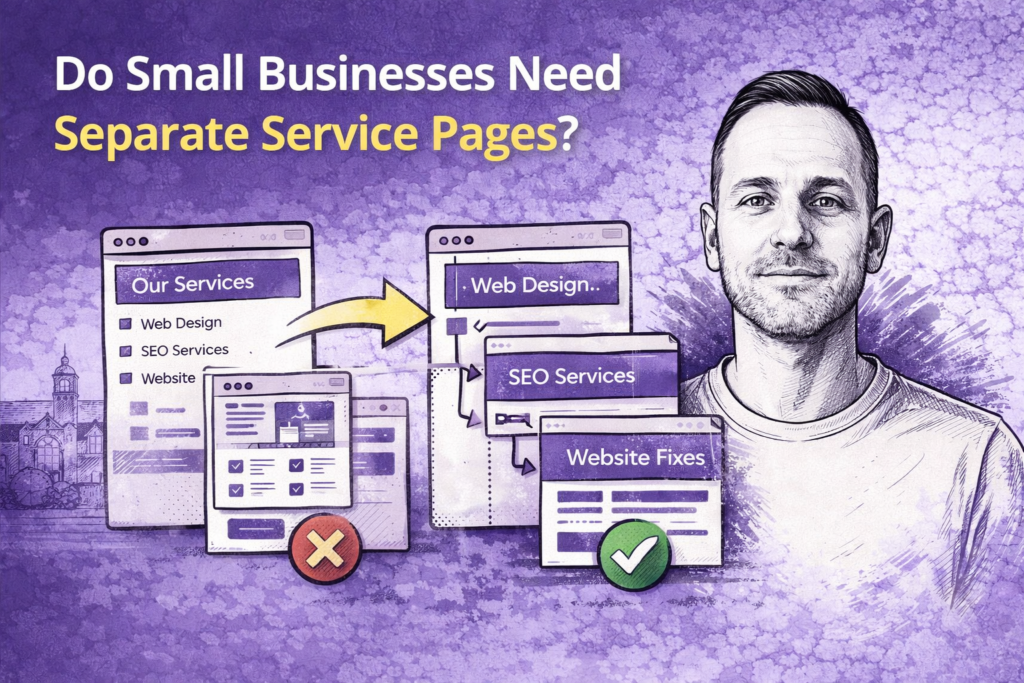
A lot of small business websites make the same mistake.
They try to cover everything on one page.
The homepage mentions every service, every area, every possible job, and hopes that will be enough. In some cases, that is better than having no detail at all. But in many cases, it holds the website back.
If you want your website to be clearer, more useful, and better set up for SEO, separate service pages are often a smart move.
Not every small business needs dozens of pages. But if you offer several distinct services, dedicated service pages can make a real difference.
What is a service page?
A service page is a page focused on one specific service your business offers.
For example, instead of having one generic page that briefly mentions everything, you might have separate pages for:
- website design
- website fixes
- SEO services
- local SEO
- WordPress support
- Shopify support
The same idea applies in other industries too. A tradesman might have separate pages for bathroom fitting, tiling, plastering or general handyman work.
The point is simple: one page, one main service, one clear focus.
Why separate service pages matter
Separate service pages help in three main ways:
- they make your website clearer for visitors
- they make your services easier to explain properly
- they give search engines clearer signals about what each page is about
That combination can improve both usability and SEO.
A visitor looking for one specific service usually wants direct information. If they land on a page that speaks clearly to that service, they are more likely to stay, trust what they are reading, and enquire.
One page trying to cover everything is often too weak
A homepage can only do so much.
If you try to use one page to rank for every service, explain every offer and cover every type of customer, the page often ends up vague.
That can lead to problems such as:
- weak service explanations
- poor keyword targeting
- less relevance for search engines
- less clarity for visitors
- fewer strong internal linking options
- a more confusing site structure
It also makes it harder to guide someone to the exact information they need.
Separate service pages can help SEO
From an SEO point of view, separate service pages often make good sense.
They allow you to create a clearer match between:
- what the visitor searched for
- what the page is about
- what the business actually offers
For example, a page about website fixes can focus on website fixes. A page about local SEO can focus on local SEO. That is much stronger than one broad page trying to rank for everything at once.
Separate service pages also give you more opportunities to improve:
- page titles
- meta descriptions
- headings
- internal linking
- service-specific content
- search intent matching
That does not mean you should create loads of thin pages for the sake of it. The pages still need to be useful.
Separate service pages can improve enquiries too
This is not just about rankings.
Separate service pages can also help generate more enquiries because they make the website more relevant to the visitor.
If someone lands on a page that clearly explains the exact service they need, they are more likely to feel:
- this business understands what I need
- this page is relevant to me
- this looks more professional
- I know what to do next
That is a much better experience than landing on a generic page with a brief list of services and no real detail.
When separate service pages make sense
Separate service pages are usually a good idea when:
- you offer clearly different services
- the services solve different problems
- people may search for those services individually
- you want each service to have its own SEO focus
- you want a clearer site structure
For example, on a web design site, it often makes sense to separate:
Those are related, but they are not the same thing. Each one deserves its own page.
When separate service pages may not be needed
Not every business needs a large set of service pages.
If your services are very closely related, or you only offer one simple core service, a single strong page may be enough.
Separate pages are not always needed when:
- the services overlap heavily
- the website is very small
- the business offers only one main service
- there is not enough real content to make each page useful
The key is not page count. It is clarity and purpose.
A few strong service pages are far better than lots of thin pages that say almost nothing.
What makes a good service page?
A good service page should do more than just mention a service name.
It should clearly explain:
- what the service is
- who it is for
- what problems it helps solve
- what is included
- why someone should choose you
- how to take the next step
Depending on the business, it may also include:
- FAQs
- examples of work
- testimonials
- location relevance
- process information
- a clear call to action
That is what turns a service page into something useful rather than just another page on the site.
Separate service pages help internal linking
This is an underrated benefit.
When your services each have their own page, it becomes much easier to link between related pages naturally.
For example:
- a homepage can link to key service pages
- blog posts can link to the relevant service
- case studies can point to the service used
- service pages can link to related support pages
That creates a stronger site structure and helps both users and search engines move through the site more easily.
Separate service pages can support local SEO too
If your business works locally, separate service pages can also support local search.
For example, a service page can later be supported by a local version or a local blog post.
That gives you a cleaner content structure, such as:
- main service page
- local service page
- supporting blog content
- case study
This is often a stronger SEO setup than trying to push everything through one broad page.
Common mistakes with service pages
A lot of businesses get this wrong in one of two ways.
1. Too few pages
Everything is squeezed into one vague page and nothing is explained properly.
2. Too many weak pages
The site has lots of pages, but each one is thin, repetitive and not useful.
The best approach usually sits in the middle.
You want enough service pages to create clarity and focus, but not so many that the site becomes padded and repetitive.
Should every service have its own page?
Not always.
A good rule is this:
If the service is important enough that a customer may search for it specifically, or if it deserves its own explanation, it probably deserves its own page.
That does not mean every tiny variation needs a page.
But your core services usually do.
A better structure usually beats a bigger site
A lot of small businesses think more pages automatically means better SEO.
That is not true.
What matters more is having the right pages.
A well-structured small site with clear service pages will usually outperform a messy site with one overloaded homepage or lots of filler pages.
The goal is not to make the site bigger. The goal is to make it clearer and stronger.
Final thoughts
Yes, many small businesses do need separate service pages.
Not because more pages always means better SEO, but because separate service pages often make the website clearer, more useful and better aligned with real search intent.
If your website currently tries to cover everything on one page, there is a good chance it could be improved with a better service-page structure.
Need help improving your website structure?
I help small businesses improve their websites so they are clearer, better organised and more effective at turning visitors into enquiries.
That can include:
- improving service-page structure
- creating clearer service pages
- fixing weak website layouts
- improving on-page SEO
- making the site easier to use
If your site feels vague, cluttered or under-structured, take a look at my website pricing or get in touch.
Need this done properly?
I work directly with small businesses on web design, WordPress fixes, Shopify support and local SEO. No agency overhead.
See web design in Blackburn →