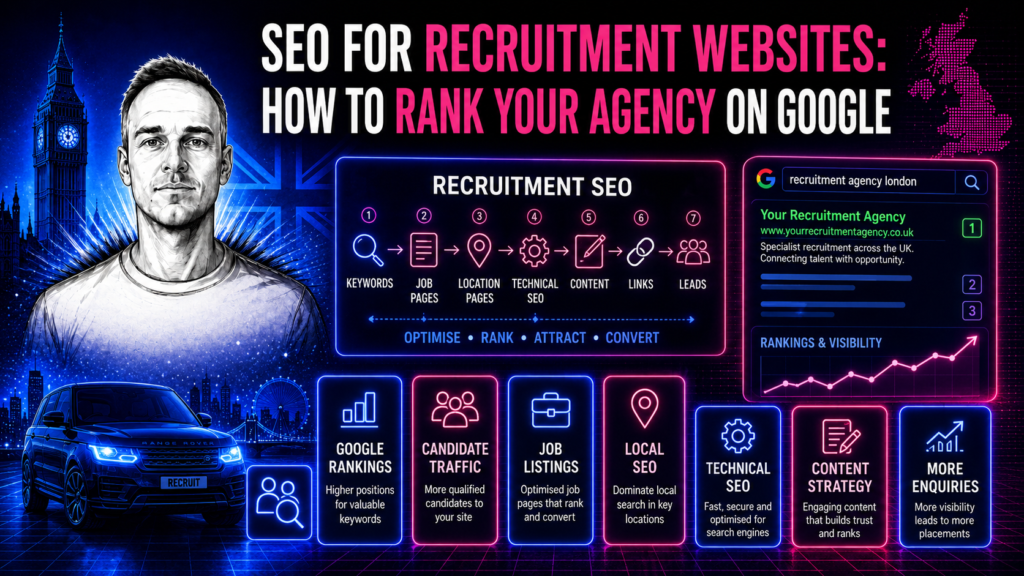
Most recruitment agency websites struggle to rank on Google. They look professional, they list the right services, and they might even have a blog — but the leads do not come in organically. The reason is almost always the same: the website was built without any real SEO strategy behind it.
Whether you are using a platform like Volcanic, running a WordPress site, or working with a custom build, the principles of ranking a recruitment website are the same. This guide covers what actually works — based on real experience building and optimising recruitment websites in the UK.
Why Most Recruitment Websites Do Not Rank
Recruitment agencies face a specific set of SEO challenges that most other businesses do not. The industry is competitive online, the content tends to be generic, and many agencies rely on job board integrations that create thin, duplicate pages.
The most common problems include having a single generic services page instead of dedicated pages for each specialism, relying entirely on job feed content that Google sees as low-value, using a platform that limits technical SEO control, having no blog or thought leadership content to build topical authority, and missing basic on-page SEO like proper title tags, meta descriptions and heading structure.
If any of these sound familiar, the good news is that they are all fixable.
Page Structure for a Recruitment Website That Ranks
The foundation of recruitment SEO is having the right pages in place. A homepage and an about page are not enough. At minimum, a recruitment website that wants to rank should have dedicated service pages for each sector or specialism — for example, IT Recruitment, Finance Recruitment, Engineering Recruitment. Each page should target a specific keyword cluster and include unique content about that vertical.
Beyond service pages, you need location pages if you recruit in specific regions. A page targeting “IT recruitment Manchester” is far more likely to rank than a generic “IT recruitment” page on a new domain. The page should include genuine local context — not just the city name inserted into a template.
A candidate-facing section also helps. Pages covering salary guides, interview tips and career advice for your sectors serve two purposes: they attract organic traffic from candidates, and they signal to Google that your site covers recruitment topics in depth.
Volcanic SEO Limitations and Workarounds
Volcanic is a popular platform for recruitment agencies, and for good reason — it handles job feeds, candidate portals and ATS integration well. However, it has known SEO limitations that agencies should be aware of.
The main issues are limited control over URL structures, restricted access to header tags and meta data on some page types, auto-generated job listing pages that can create thin content at scale, and difficulty implementing custom structured data or schema markup.
If you are on Volcanic, the most important things you can do are write substantial unique content on every page you can control, ensure your Volcanic SEO settings are properly configured (titles, descriptions, canonical tags), avoid publishing hundreds of near-identical job pages that dilute your site quality, and supplement your Volcanic site with a blog or content hub — even if hosted on a subdomain.
For agencies with the budget, a WordPress site with a Bullhorn or Broadbean integration often gives more SEO flexibility than Volcanic while still handling job feeds and candidate management.
Bullhorn Integration and SEO
If you use Bullhorn as your ATS, the way jobs are fed to your website matters for SEO. A basic iframe embed of your Bullhorn job feed will not help your rankings at all — Google cannot crawl iframe content effectively.
Instead, use an API integration that pulls job data into native WordPress or HTML pages. Each job should have its own URL, a proper title tag, structured content (location, salary, description), and ideally JobPosting schema markup. This turns your job feed from an SEO liability into an asset — each job page becomes a potential landing page for long-tail searches.
The same principle applies to other ATS platforms like Broadbean, JobAdder and Vincere. The API integration approach is always preferable to embedded feeds.
Content Strategy for Recruitment SEO
Content is where recruitment agencies can genuinely differentiate themselves in search results. Most agencies either have no blog at all or post sporadic, generic articles that add no SEO value.
A content strategy that works for recruitment focuses on three types of content. First, sector insight articles — market updates, salary trends and hiring challenges in the industries you specialise in. These build topical authority and attract both clients and candidates. Second, practical candidate resources — CV templates, interview preparation guides and career transition advice specific to your sectors. These generate consistent search traffic year-round. Third, client-facing guides — content like “how to write a job description that attracts top talent” or “the true cost of a bad hire in engineering.” These target the decision-makers you want as clients.
Publishing two to three quality articles per month consistently will build your organic traffic over six to twelve months. One exceptional article per month is better than four mediocre ones.
Technical SEO for Recruitment Websites
Beyond content, there are several technical factors that affect how well recruitment websites rank.
Page speed matters — recruitment websites with heavy job feeds, candidate portals and third-party integrations tend to be slower than average. Run your site through Google PageSpeed Insights and address any issues scoring below 50 on mobile. Common fixes include optimising images, reducing unnecessary JavaScript from tracking scripts and ATS widgets, and ensuring your hosting can handle the load.
Mobile responsiveness is non-negotiable. Over 60 percent of job seekers browse on mobile. If your job listings, application forms or service pages are difficult to use on a phone, you are losing both rankings and candidates.
Schema markup should be implemented on every job listing page (JobPosting schema), your homepage (Organization schema), and any FAQ sections on service pages (FAQPage schema). This increases your chances of appearing in rich results and Google for Jobs.
Internal linking ties everything together. Your service pages should link to relevant blog posts, job listing pages should link back to the parent sector page, and your blog should consistently link to your service and contact pages.
Local SEO for Recruitment Agencies
If you recruit within specific regions, local SEO is essential. Set up and complete your Google Business Profile with your office location, service areas, and a thorough business description that mentions your key sectors and locations.
Create location-specific service pages — “IT Recruitment Leeds”, “Finance Recruitment Birmingham” — with unique content for each. Do not just swap the city name in a template. Include genuine local context: mention local employers, industry clusters, transport links or office parks in the area. Google can detect templated content and it will not rank.
Collect Google reviews from placed candidates and satisfied clients. Even five genuine reviews puts most recruitment agencies ahead of their local competitors, because very few agencies actively manage their Google Business Profile.
How Long Does Recruitment SEO Take?
SEO for recruitment websites follows the same timeline as any other industry. On a new or newly optimised site, expect to wait four to eight weeks before seeing any movement in search positions. Long-tail keywords — specific job titles, niche sector terms — will rank first. Competitive terms like “recruitment agency Manchester” typically take six to twelve months of consistent work.
The compound effect is what matters. Each new piece of quality content, each new service page, each review collected — they all contribute to your domain authority over time. Agencies that commit to twelve months of consistent SEO work see dramatically different results to those that try it for three months and give up.
What to Do Next
If your recruitment website is not generating organic enquiries, start with an honest audit. Check whether you have dedicated pages for each specialism, whether your job feed is properly integrated (not iframed), whether your content is unique and substantial, and whether your Google Business Profile is set up and active.
If you need help with any of this — whether it is a full website rebuild, a Bullhorn or ATS integration, or ongoing SEO support — get in touch. I have built recruitment websites from scratch and optimised existing Volcanic and WordPress recruitment sites. You can also see my pricing for an idea of costs, or read about how much a recruitment website costs for a detailed breakdown.
Frequently Asked Questions
How much does SEO cost for a recruitment website?
Ongoing SEO for a recruitment agency typically costs between £500 and £2,000 per month depending on the scope. A one-off technical audit and optimisation can cost £500 to £1,500. Content creation and link building are usually charged separately.
Is Volcanic good for SEO?
Volcanic is functional for SEO but has limitations around URL control, meta data access and schema markup. It works well enough if you write strong unique content on every page, but a WordPress site with a Bullhorn API integration generally offers more flexibility for agencies serious about organic growth.
Should I use Bullhorn or Broadbean for my website job feed?
Both work well when integrated via API rather than iframe. The choice usually depends on which ATS you already use. The important thing is that jobs are rendered as native pages with proper URLs, not embedded widgets that Google cannot crawl.
How long before my recruitment website starts ranking?
Long-tail keywords can start ranking within four to eight weeks. Competitive terms like city-level recruitment queries typically take six to twelve months. Consistency matters more than speed — agencies that publish quality content regularly see the best results.
Do I need a blog on my recruitment website?
Yes. A blog targeting sector insights, candidate resources and client-facing guides builds topical authority that helps all your pages rank better. Two to three quality posts per month is a good target for most agencies.
Need help with your website?
I work directly with small businesses on web design, WordPress fixes, Shopify support and local SEO. No agency overhead.
Get in touch →