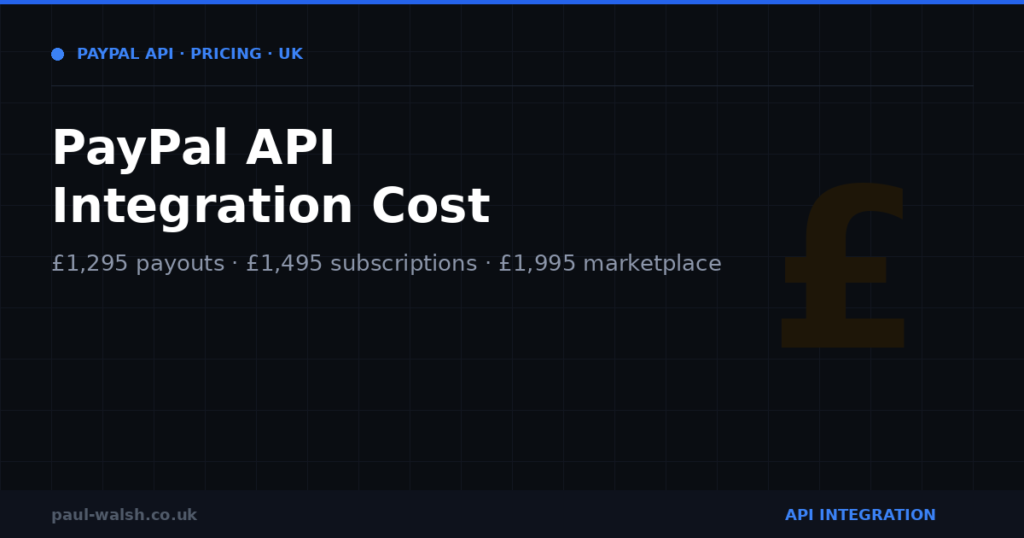
PayPal API access is free — there are no API licence charges. The cost of integration is the development work: authentication, business logic, webhook handling and connecting to your platform. That development cost ranges from £1,295 for a PayPal Payouts integration to £1,995 for a marketplace checkout build. On top of the build cost, PayPal charges per transaction — 2% capped at £1 for Payouts, approximately 2.99% + 49p for receiving payments.
Build tiers
PayPal Payouts: £1,295
Automated disbursement to multiple PayPal accounts from your platform. Recipients identified by PayPal email address, amounts driven by your platform data. Individual or batch payout calls, webhook handling for payout confirmation and failure, failed payout logging and alerting, full audit trail. For marketplace seller payments, affiliate commission disbursements and contractor payouts where recipients have and want PayPal.
Includes the production Payouts access application guidance — PayPal requires separate approval for live Payouts which should be applied for before the build starts. Timeline: approximately one week.
Subscriptions: £1,495
PayPal Billing Plans for recurring subscription payments. Plan creation, subscription setup, billing cycle management, failed payment handling and subscription cancellation. Customer billing agreement authorisation flow built into your platform. Webhook handling for payment completed, payment failed and subscription cancelled events. For businesses whose customers specifically want to manage subscriptions via PayPal rather than card.
Timeline: approximately one to one-and-a-half weeks.
Marketplace and custom checkout: £1,995
Custom PayPal checkout for bespoke platforms, marketplace payment splitting, Pay Later integration, or PayPal alongside Stripe in a unified multi-gateway checkout. Orders API implementation, client-side SDK configuration, server-side capture, refund automation and full webhook lifecycle management. For platforms that don’t have a PayPal plugin, need Pay in 3 surfaced correctly, or need payment splitting between platform and sellers.
Timeline: approximately two weeks.
PayPal’s ongoing transaction fees
These are PayPal’s own charges, paid directly to PayPal, separate from the build cost:
Payouts: 2% per payout, capped at £1 for GBP payouts. A £50 payout costs £1 (at the cap). A £10 payout costs 20p. International payouts in foreign currencies add a 2.5% conversion fee.
Receiving payments: approximately 2.99% + 49p per transaction. Higher than Stripe’s standard rate of 1.5% + 20p for European cards. For a £100 payment, PayPal costs £3.48 vs Stripe’s £1.70. Volume discounts available on negotiated merchant rates.
Subscriptions: same receiving rate as standard payments — 2.99% + 49p per billing event.
What drives the build cost up
Marketplace complexity. PayPal Commerce Platform for true marketplace payment splitting — onboarding sellers, managing connected accounts, splitting payments at capture time — is significantly more complex than standard checkout. Add £500–£800 to the marketplace tier for full Commerce Platform implementation.
Xero reconciliation. Adding automatic Xero reconciliation — payout batches creating Xero entries, PayPal fees logged separately, bank transfers reconciled — adds approximately £400–£500 to any tier.
Complex payout logic. Simple fixed-amount payouts are fast to build. Variable amounts calculated from complex earnings logic, tiered commission structures, or payouts that depend on multiple conditions in your database take longer to design and test.
Legacy platform integration. Connecting PayPal to a clean modern REST API platform is straightforward. Integrating with a legacy system, a bespoke CRM with limited API access, or a platform with unusual data structures takes additional time.
PayPal vs Revolut for payouts — cost comparison
For businesses deciding between PayPal Payouts and Revolut Business API for automated disbursements, the fee structure is an important factor. PayPal charges 2% capped at £1 per payout. Revolut Business payments to UK bank accounts are typically included in the Revolut Business plan — effectively free per transaction above a plan threshold.
For 200 payouts of £50 each per month: PayPal costs £200 (2% x £50 x 200 = £200, but capped at £1 each = £200). Revolut costs near zero in per-transaction fees (assuming Revolut Business plan covers the volume). The £500 difference per month — £6,000 per year — justifies using Revolut for UK bank transfer payouts if recipients are happy to receive bank transfers rather than PayPal payments.
PayPal Payouts is worth the fee when recipients specifically need or prefer PayPal, particularly for international payments where PayPal’s global reach is a practical advantage. See Revolut Business API integration for the bank transfer alternative.
For the full service details, see the PayPal API integration service. For the Payouts API specifically, see PayPal Payouts API integration. For how PayPal compares with Stripe, see PayPal vs Stripe.
Related posts
- PayPal API integration: a complete guide
- PayPal Payouts API integration
- PayPal vs Stripe: which is right for your business?
- PayPal checkout for custom platforms
Build timeline and what to prepare
Before the build starts you need: an active PayPal Business account with developer access enabled, the Payouts API production approval applied for (if building Payouts — apply early, it can take several days), and access to your platform for integration. PayPal sandbox access is immediate and development starts in sandbox regardless of where the production approval is in the process.
A practical note on PayPal’s integration timeline compared to other payment APIs on this site: PayPal integrations consistently take slightly longer to build and test than equivalent Stripe integrations. The PayPal sandbox occasionally behaves differently from production, webhook delivery can be slower in sandbox, and some documentation gaps require more careful testing. Budget an extra day or two for thorough PayPal testing compared to Stripe.
Is custom integration worth it over a plugin?
For WooCommerce stores needing standard PayPal checkout: no, the plugin is sufficient. For any of the following: probably yes. A custom platform with no PayPal plugin. Pay Later that needs to display correctly as a distinct option. Automated Payouts to multiple recipients. Marketplace payment splitting. PayPal alongside Stripe in a unified checkout that tracks both payment methods in your order management system. Programmatic refunds triggered by your own order events rather than manual dashboard clicks. For each of these, a custom integration delivers something the plugin cannot.
If you need help with a custom API integration for your website or business application, I can help. I build bespoke API integrations for UK businesses. See API integration pricing or get in touch to discuss your project.
Need a custom integration built?
I build custom API integrations — Stripe, Companies House and bespoke data pipelines. Reliable, well-documented, no agency overhead.
Discuss your project →