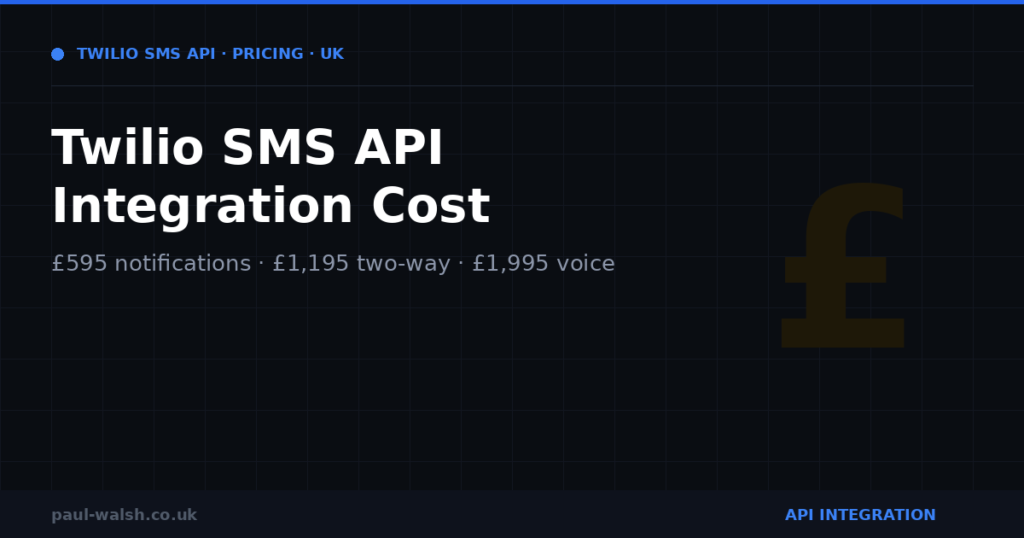
The Twilio SMS API is simple to integrate with — sending an SMS is a single API call. The build cost reflects the surrounding work: the trigger logic, dynamic message content, UK sender registration, inbound reply handling, error handling and testing. For most businesses, a complete SMS notification integration costs between £595 and £1,195, with the range depending on whether two-way messaging or Twilio Verify 2FA is required. Ongoing Twilio messaging costs are around 4–5p per UK SMS.
Build tiers
Outbound SMS notifications: £595
Automated one-way SMS triggered by events in your platform. Order confirmations, appointment reminders, despatch notifications, payment alerts — messages sent automatically when the trigger fires. Dynamic content from your database, UK sender ID or number setup, UK A2P registration, delivery status callbacks and error handling. For WooCommerce stores, booking systems, service businesses and any platform where the primary need is sending automated messages to customers.
This is the most common Twilio build and the most straightforward. The Twilio API call itself is a few lines of code — the build time is in the trigger logic, message formatting, testing across real UK networks and completing the UK sender registration process. Timeline: approximately 3–5 days.
Two-way messaging and Verify: £1,195
Everything in the outbound tier, plus inbound SMS webhook handling for two-way conversations, and Twilio Verify for SMS OTP and phone number verification. Two-way messaging adds: an inbound webhook endpoint, keyword recognition (YES/NO confirmations, STOP opt-out, custom keywords), reply routing and status write-back to your system. Twilio Verify adds: the start and check verification flow, rate limiting, brute-force protection and voice fallback. For platforms needing appointment confirmation replies, user registration verification or two-factor authentication.
Timeline: approximately one week.
Voice and IVR: £1,995
Automated outbound voice calls, inbound call routing and IVR (Interactive Voice Response) menus built with Twilio’s TwiML. Appointment reminders delivered by voice call rather than SMS (useful for older demographics less comfortable with text), automated payment chasing calls, inbound call routing to the right team member based on caller input. A different audience from SMS — voice is more complex to build and test, and requires careful scripting of the call flow. Timeline: approximately two weeks.
What drives the cost up
Complex trigger logic. A single trigger (“send when order status changes to Shipped”) is fast. Multiple triggers with conditional logic (“send different messages based on product category, order value and whether the customer is a first-time buyer”) takes longer to design and test.
Multi-step reminder sequences. A single reminder is simple. A timed sequence — 48-hour reminder, 24-hour reminder, 2-hour reminder, post-appointment follow-up — requires scheduling logic, a queue system and careful handling of cancellations mid-sequence (don’t send the reminder if the appointment was cancelled between the 24-hour and 2-hour message).
Custom inbound routing. Simple keyword handling (YES/NO/STOP) is straightforward. Building a conversational SMS flow where inbound messages are routed to different handlers based on context, or integrating with a team inbox for human handoff, adds significant scope.
Legacy platform integration. Connecting Twilio to a clean modern platform with webhook support is fast. Integrating with a legacy booking system with no API, a bespoke CRM with limited access, or a system that requires screen-scraping to read appointment data takes longer.
Ongoing Twilio costs
Twilio charges per message sent. UK outbound SMS costs approximately 4–5p per message (check current Twilio pricing as this changes). A business sending 500 SMS per month pays around £20–25/month to Twilio. A business sending 5,000 SMS per month pays around £200–250/month. These costs are entirely separate from the build cost and are paid directly to Twilio.
UK phone number rental is approximately £1–2/month per number for a long number, more for short codes. Twilio Verify costs approximately 5p per verification attempt, billed separately from standard SMS.
For businesses with high SMS volumes, Twilio offers volume pricing at certain thresholds. The cost per message decreases with volume — worth exploring with Twilio directly if monthly volumes are significant.
For the full service details, see the Twilio SMS API integration service. For appointment reminders specifically, see SMS appointment reminders with Twilio. For 2FA, see Twilio two-factor authentication. For WooCommerce, see Twilio WooCommerce SMS notifications.
Related posts
- Twilio SMS API integration: a complete guide
- SMS appointment reminders with Twilio
- Twilio two-factor authentication via SMS
- Twilio WooCommerce SMS notifications
Comparing build cost to alternatives
The main alternatives to a custom Twilio integration for SMS notifications are off-the-shelf SMS marketing platforms and WooCommerce plugins.
SMS marketing platforms like Klaviyo SMS, Omnisend or TextMagic charge monthly fees typically based on message volume or a subscription tier. A business sending 1,000 messages per month might pay £30–£80/month to a platform. Over two years that’s £720–£1,920 in ongoing platform fees, plus the per-message costs. A custom Twilio integration at £595 with direct Twilio messaging costs works out cheaper within 12–18 months for most volumes, with no platform dependency and full control over the trigger logic.
WooCommerce SMS plugins typically cost £50–£150/year. They’re fine for basic order status SMS with standard WooCommerce workflows. The limits appear quickly: you can’t change the trigger logic, you can’t add custom message content beyond basic tokens, you can’t handle inbound replies, and you’re dependent on the plugin developer maintaining compatibility with WooCommerce updates. A custom integration at £595 is a one-time cost that gives you full control.
What the build actually takes
To be transparent about what drives this pricing: the Twilio SMS API itself is simple. Sending a message is a few lines of code. The build time is in the surrounding work — the trigger logic in your specific platform, the message formatting with dynamic content, the UK A2P sender registration process (a form submission, but takes time to be approved), testing across real UK mobile networks, error handling for failed deliveries and malformed phone numbers, and handover documentation. None of that is complex engineering, but it’s all necessary for an integration that works reliably in production.
The pricing reflects honest time rather than complexity. £595 for a 3–5 day build that includes setup, testing and registration is competitive and fair. It’s not a technically difficult project, but it’s also not something that takes 30 minutes — done properly, with UK registration, thorough testing and clean documentation, it takes several days of focused work.
If you need help with a custom API integration for your website or business application, I can help. I build bespoke API integrations for UK businesses. See API integration pricing or get in touch to discuss your project.
Need a custom integration built?
I build custom API integrations — Stripe, Companies House and bespoke data pipelines. Reliable, well-documented, no agency overhead.
Discuss your project →