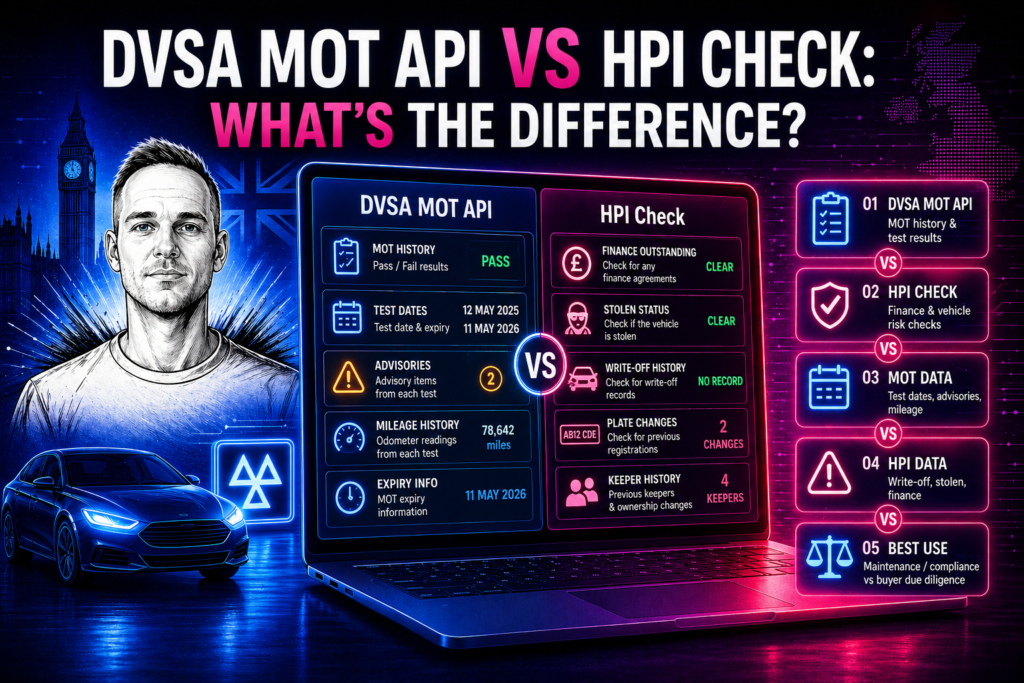
The DVSA MOT History API and HPI (and similar commercial vehicle check services) are frequently compared as if they’re alternatives. They’re not — they return completely different data, serve different purposes, and for most use cases you need both. This post explains exactly what each provides, where they overlap, and how to decide which your platform needs.
What the DVSA MOT History API provides
The DVSA API returns the official MOT test record from the government database — every MOT test conducted on the vehicle, with pass or fail result, test date, mileage at test, failure reasons and advisory notices. It also returns the current MOT expiry date and basic vehicle details. That’s it. MOT history only. Cost: The API is free. A custom integration costs from £895 as a one-off build fee, with no ongoing per-lookup charges.
What HPI and commercial vehicle checks provide
HPI aggregates data from multiple sources: outstanding finance, written-off history (Categories S, N, A and B), stolen markers, keeper changes, mileage discrepancy alerts, MOT history, DVLA data (tax status, registered colour, engine size), and plate changes. Cost: Per lookup or subscription. Typical costs range from £2 to £20 per check depending on the data package.
Where they overlap
Both return MOT history from the same DVSA database. Both return basic vehicle details from the same underlying DVLA and DVSA source data. The difference is that HPI includes MOT data as one component of a broader check, while the DVSA API provides MOT data only.
Which one does your platform actually need?
You need the DVSA API if: MOT history is the specific data you need. A dealer website showing MOT history on listings. A fleet management system monitoring MOT expiry dates. A part-exchange tool using mileage history from MOT records. All MOT-only use cases — the DVSA API is free and purpose-built for them.
You need a commercial provider if: you need finance checks, write-off history, stolen markers, or keeper changes. Any platform where users are making buying decisions needs this data.
You likely need both if: you’re building a comprehensive used car platform. Show the free DVSA MOT history directly — it’s live, authoritative and costs nothing per lookup. Run a full HPI check for buyers who want the complete picture.
The practical cost comparison
A dealer doing 100 vehicle checks a month at £5 per HPI check spends £6,000 a year on checks. If those checks are primarily for MOT history, switching to direct DVSA API integration costs £895 once, then nothing per lookup. If those checks are for finance and write-off verification before purchasing vehicles, the HPI cost is justified — the DVSA API doesn’t replace that.
The honest summary
The DVSA MOT API is better than HPI for MOT history specifically — it’s free, it’s the same data, and direct integration means you can display it however you want. HPI is necessary for everything beyond MOT history. Most serious used car platforms use both. Start with the DVSA API — it’s free, the build is fast, and the trust signal of showing live MOT history on listings is immediate.
For the DVSA integration build, see the DVSA MOT API integration service and try the live MOT History demo. For the cost breakdown, see how much DVSA MOT API integration costs.
Related posts
Need a custom integration built?
I build custom API integrations — Stripe, Companies House and bespoke data pipelines. Reliable, well-documented, no agency overhead.
Discuss your project →