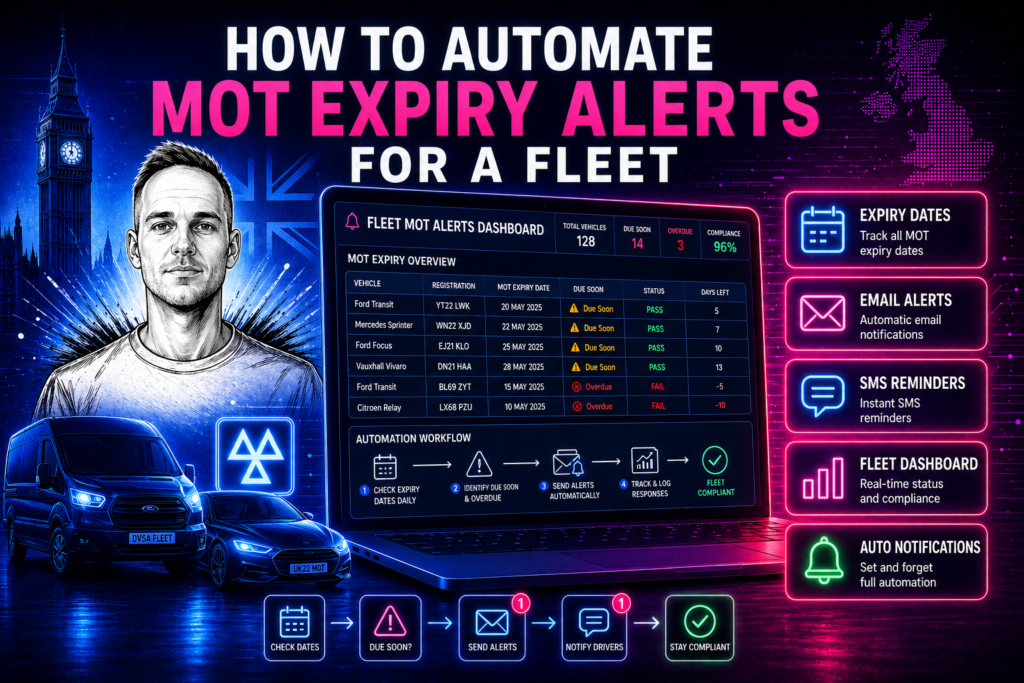
Manual MOT tracking is one of the most common compliance failures in fleet management. Someone is supposed to check which vehicles are due, add reminders to a calendar, follow up with drivers. In practice, it gets missed — especially across larger fleets where the workload is spread across multiple people and spreadsheets. An automated MOT expiry monitoring system using the DVSA API eliminates that failure point. Every vehicle in the fleet is checked on a schedule, expiry dates are compared against thresholds, and alerts fire automatically before any vehicle expires.
What the automated system does
At its simplest, the system does four things on a daily schedule: fetch the current MOT expiry date for every registration in the fleet from the DVSA API, compare each expiry date against configurable thresholds (30 days, 14 days, 7 days is common), generate an alert for any vehicle within a threshold, and deliver that alert by email, Slack message or webhook. The result is a daily digest of vehicles approaching MOT expiry, delivered automatically. A vehicle that expires in 28 days appears in the 30-day alert. If it still hasn’t been booked in, the 7-day alert has fired three times and there is a documented record that the alert was sent.
The compliance value beyond convenience
For regulated fleet operators — hire and reward, haulage, coach operators — an auditable record of MOT monitoring is a compliance requirement. The Health and Safety Executive and the Traffic Commissioner both expect operators to demonstrate systems are in place to ensure vehicles are roadworthy. A documented automated monitoring system with log files showing when checks were run, what the results were, and when alerts were sent is a stronger compliance record than a spreadsheet.
How the DVSA API handles fleet lookups
The DVSA MOT History API supports bulk lookups as well as individual registration lookups. The API returns the current MOT expiry date as a top-level field on the vehicle record — so the monitoring system doesn’t need to iterate through the full test history. Results are stored with a timestamp after each check run, creating the audit log.
What the build involves
The fleet monitoring build adds three components on top of a standard MOT lookup integration: a scheduler (typically a cron job) that runs checks on a defined cadence, a threshold comparison and alert generation layer, and a notification delivery mechanism. The full fleet is stored as a list of registrations in a database table. Adding a vehicle to monitoring is adding its registration to the table.
What this doesn’t cover
MOT expiry monitoring covers one compliance obligation. Tax status and SORN are available via the DVLA Vehicle Enquiry Service — a separate API that can be added alongside if needed.
For complete build details and pricing, see the DVSA MOT API integration service. The Fleet Monitoring tier is £2,295. See what the underlying data looks like in the live MOT History demo. For the full pricing breakdown, see the integration cost post.
Related posts
Need a custom integration built?
I build custom API integrations — Stripe, Companies House and bespoke data pipelines. Reliable, well-documented, no agency overhead.
Discuss your project →