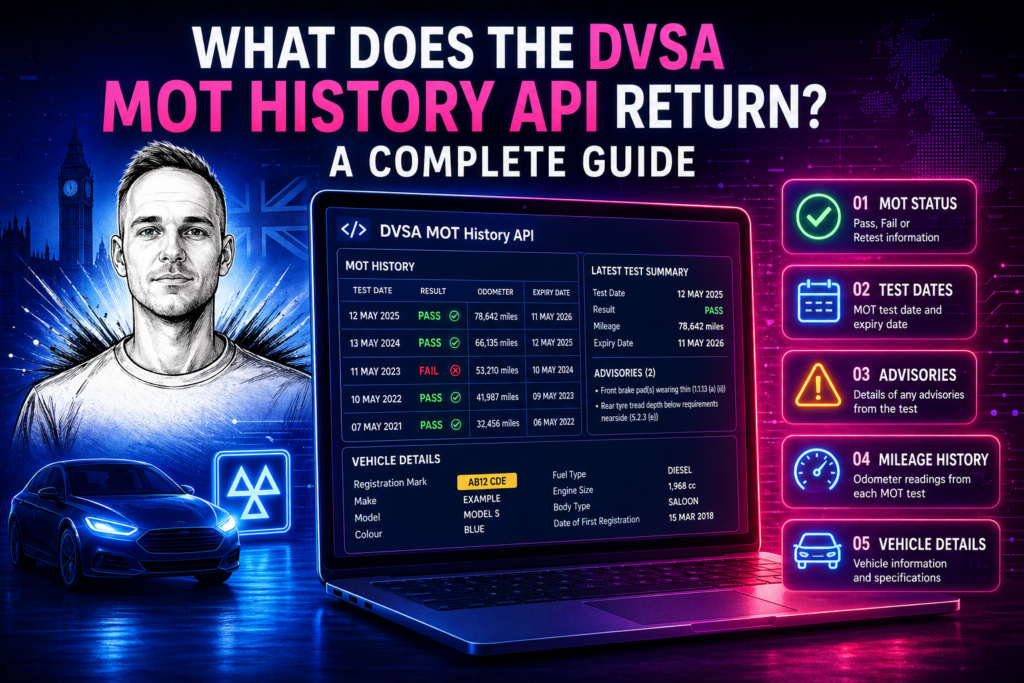
The DVSA MOT History API is a free official government API that returns the complete MOT test record for any UK vehicle by registration number. It covers cars, motorcycles, vans, HGVs, buses and coaches — the full MOT testing universe in Great Britain and Northern Ireland. This post covers exactly what it returns, how the API works, what authentication it requires, and what’s realistically buildable with it.
What data does the DVSA MOT History API return?
For each vehicle, the API returns two categories of data: the vehicle record and the MOT test history.
Vehicle record
Make, model, primary colour, fuel type, engine size, date of first registration and registration number. This is the DVSA’s record of the vehicle — the same information held against the registration in the MOT system.
MOT test history
An array of every MOT test on record for the vehicle, each containing: test result (passed or failed), test completion date, test expiry date (for passed tests), odometer reading at time of test, MOT test number, test station details, and reasons for failure and advisory notices — each with text, category, and whether it was dangerous. Tests are returned most recent first. The response also includes the current MOT expiry date as a top-level field.
What vehicle types does it cover?
The new unified API covers all vehicle types in a single endpoint. Cars, motorcycles and vans — GB from 2005, Northern Ireland from 2017. HGVs, trailers, buses and coaches — GB from 2018, Northern Ireland from 2017. Vehicles exempt from MOT are included in the vehicle record but will have no test history. Electric vehicles are covered and their MOT history appears in the same structure as combustion vehicles.
How does the authentication work?
The current DVSA MOT API uses OAuth 2.0 via Microsoft Azure — not a simple API key. DVSA issues three credentials when your application is approved: a client ID, a client secret and a tenant ID. These are used to request a Bearer access token from the Azure token endpoint. That token, plus a separate X-API-Key header, must accompany every request to the MOT API. Access tokens are valid for 60 minutes. A properly built integration caches the token for its full lifetime. Client secrets expire every two years — the most common cause of MOT API integrations suddenly stopping working.
What are the API endpoints?
The base URL is https://history.mot.api.gov.uk. The primary endpoint for most use cases is lookup by registration: GET /v1/trade/vehicles/registration/{registration}. Additional endpoints allow lookup by VIN and bulk lookups by page — useful for processing large datasets.
What are the rate limits?
DVSA manages rate limits at the API key level. For standard development and small commercial use, the limits are generous enough that a properly cached integration will rarely approach them. High-volume use cases should confirm limits with DVSA during the application process.
What can you build with it?
The most common use cases are MOT history display on used car dealer listings, automated checks in car-buying and part-exchange tools, MOT expiry monitoring for fleet management systems, and MOT history lookup in vehicle insurance or warranty applications. You can see a live example of what the API returns in the MOT History Checker demo tool. For what a build costs, see the DVSA MOT API integration service.
Related posts
- How much does DVSA MOT API integration cost?
- DVSA MOT API vs HPI check: what’s the difference?
- DVSA MOT API authentication: API keys, rate limits and error handling
If you need help integrating the DVSA MOT API into your website or application, I can help. I build custom API integrations for businesses across the UK. See API integration pricing or get in touch to discuss your project.
Need a custom integration built?
I build custom API integrations — Stripe, Companies House and bespoke data pipelines. Reliable, well-documented, no agency overhead.
Discuss your project →