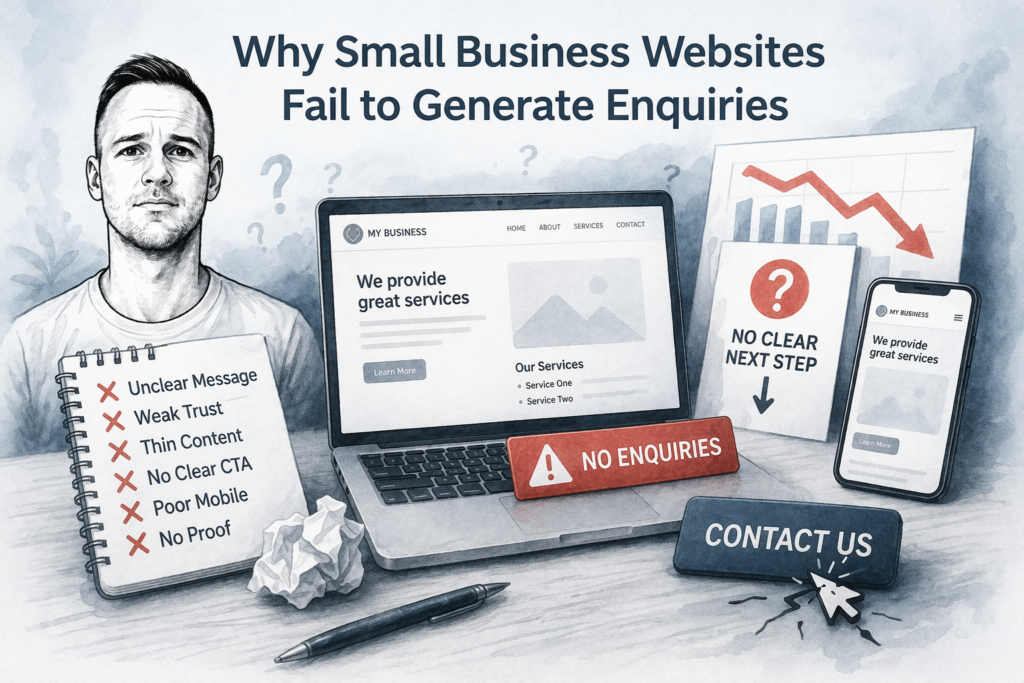
A lot of small business websites look fine on the surface, but they still do not generate many enquiries.
That can be frustrating, especially when time and money have already gone into getting the site online.
The problem is usually not just that the website exists. It is that the website is not doing enough to help visitors quickly understand the business, trust it, and take the next step.
In many cases, the issue is not traffic alone. It is the way the website presents the business once people arrive.
A Website Can Be Live and Still Underperform
A website does not need to be completely broken to underperform.
A lot of sites fail quietly. They:
- look a bit dated
- feel unclear
- make the business seem smaller or less professional than it really is
- do not explain services properly
- give visitors no strong reason to contact the business
Because of that, people land on the site, have a quick look, and leave.
1. The Message Is Not Clear Enough
One of the biggest problems on small business websites is weak messaging.
A visitor should be able to understand very quickly:
- what the business does
- who it helps
- where it works
- what action they should take next
If the homepage or service pages are too vague, the site creates friction immediately.
A lot of websites talk in general terms but do not clearly explain the actual service offer. When that happens, the visitor has to work too hard to figure things out.
Most people will not do that. They will move on.
2. The Website Does Not Build Enough Trust
Trust matters more than many businesses realise.
If a website looks:
- outdated
- incomplete
- generic
- messy on mobile
- poorly written
- missing key information
it makes the business feel less credible.
People are often deciding quickly between several options. If your website looks less trustworthy than the others, that affects enquiries even if your actual service is better.
Trust signals can include:
- clear service pages
- professional design
- strong contact information
- case studies
- reviews
- good photography or visuals
- a site that feels current and maintained
3. Calls to Action Are Weak or Missing
A lot of websites do not make the next step obvious enough.
Visitors should not have to guess what to do next.
Common problems include:
- no visible contact button
- weak call-to-action wording
- enquiry forms buried at the bottom
- service pages with no clear next step
- too many competing links or distractions
If the site does not guide people towards contacting you, it is much less likely to convert.
4. Service Pages Are Too Thin
Many small business websites have weak service pages.
They may mention the services briefly, but not clearly enough to:
- explain what is included
- build trust
- show relevance
- support SEO
- help visitors feel ready to enquire
A good service page should help someone quickly understand:
- what the service is
- whether it is relevant to them
- why they should trust the business
- how to get in touch
If the page is too thin, it does not do enough work.
5. The Site Is Not Strong on Mobile
A lot of small business traffic comes from mobile devices.
If the site feels awkward on a phone, that alone can reduce enquiries.
Common mobile issues include:
- cramped layouts
- text that is hard to read
- confusing menus
- buttons too small or hard to tap
- forms that are awkward to use
- sections that feel too long or messy
A site might seem acceptable on desktop but still underperform badly on mobile.
6. The Website Looks Like a Placeholder
This is more common than people think.
A business may have a website, but it still feels unfinished.
That can happen when:
- stock copy has not been improved
- images feel generic
- sections are too thin
- pages are missing depth
- the site lacks real proof
- there is very little content beyond the basics
A placeholder-style site may be technically live, but it does not do enough to persuade visitors.
7. The Structure Is Weak
Sometimes the problem is not design alone. It is the overall structure.
If the site navigation is unclear or the pages are poorly organised, visitors can struggle to find what they need.
Common structural issues include:
- too few service pages
- services grouped too vaguely
- poor internal linking
- key pages buried in the menu
- weak homepage flow
A better structure often improves both usability and SEO.
8. The Site Does Not Match the Business Properly
Some businesses outgrow their websites.
The site may have been built:
- too early
- too cheaply
- too quickly
- before the business was fully defined
As the business evolves, the website can stop reflecting where the company is now.
That means the site may no longer match:
- the quality of the work
- the type of clients being targeted
- the services being offered
- the reputation of the business
When that happens, the site starts holding the business back.
9. There Is No Real Proof
Proof matters.
A site that makes claims without showing anything to support them can feel weak.
That does not mean every business needs endless testimonials or case studies straight away. But even simple proof helps:
- a case study
- examples of work
- clear service explanations
- real location/service relevance
- reviews
- evidence of experience
Without that, the site can feel generic.
10. The Website Was Built to Exist, Not to Convert
This is the real issue behind many underperforming websites.
Some websites are built just to say the business has one. They are not built to:
- guide people properly
- support trust
- answer real buying questions
- strengthen local relevance
- make enquiry actions easy
A website should not just be an online leaflet. It should help move people towards contact.
More Traffic Is Not Always the First Fix
A lot of businesses assume the answer is simply “get more traffic.”
Sometimes that is true. But if the website itself is weak, more traffic does not solve the real problem.
In fact, it can just mean more people arriving and leaving without taking action.
In many cases, the better first move is improving:
- messaging
- structure
- service pages
- calls to action
- mobile usability
- trust signals
Then the traffic you do get has a better chance of converting.
What Usually Helps
If a small business website is not generating enquiries, the most useful improvements are often practical ones:
- clearer homepage messaging
- stronger service pages
- better calls to action
- mobile improvements
- clearer navigation
- more trust signals
- more complete contact details
- better internal linking
- support content that answers buyer questions
These things often make more difference than businesses expect.
Fix It or Rebuild It?
Some websites can be improved with practical changes.
Others have deeper structural problems and are better rebuilt properly.
The right answer depends on whether the current website is still a sensible base to build on.
If the site is mostly sound, fixes can help a lot. If the foundation is weak, a rebuild may be the better investment.
Final Thoughts
Small business websites usually fail to generate enquiries for one simple reason:
They do not do enough to build clarity, trust and momentum.
If visitors cannot quickly understand what you do, trust the business, and see what to do next, the website will underperform.
The good news is that a lot of these problems are fixable. In some cases, a few focused improvements can make a real difference. In others, the better answer is rebuilding the site properly so it supports the business better.
Need Help Improving a Website?
If your website is not generating the enquiries it should, I can help identify what is holding it back and whether the best move is practical fixes or a stronger rebuild.
Take a look at my Website Design page, Website Fixes page, check my website pricing, or get in touch to discuss your site.
Need this done properly?
I work directly with small businesses on web design, WordPress fixes, Shopify support and local SEO. No agency overhead.
See web design in Blackburn →