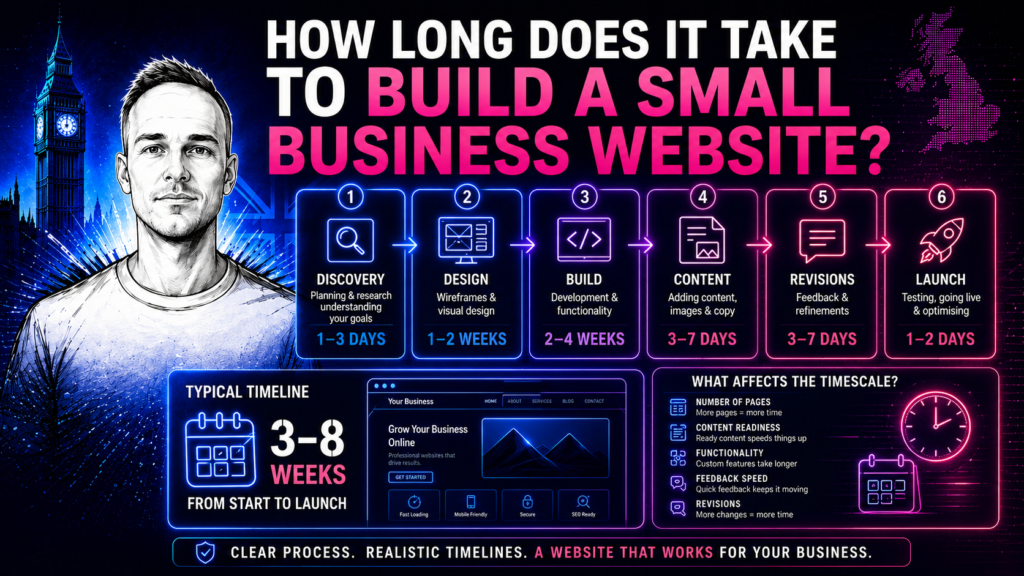
When a small business owner asks how long a website will take, they usually want a straight answer. The problem is that timelines vary enormously depending on what is being built, who is building it, and how quickly decisions get made.
This guide gives realistic timelines for different types of websites, explains what affects the speed of a project, and covers the things you can do to keep your build on track.
Realistic Timelines by Website Type
Simple brochure website (3–5 pages): 1–2 weeks. A homepage, about page, services page, and contact page with a form. This is the most common type of small business website and the fastest to build. If content is ready upfront, a good developer can have this live within a week.
Standard business website (5–15 pages): 2–4 weeks. Multiple service pages, a blog, contact forms, Google Maps, and more detailed content. The extra time comes from designing and building more pages, writing or formatting more content, and setting up SEO for each page.
Ecommerce website: 3–6 weeks. Product listings, payment processing, shipping setup, customer accounts, and checkout testing. Even a simple store needs thorough testing before launch. Complex stores with hundreds of products, custom features, or API integrations can take 6–12 weeks.
Custom or complex builds: 6–16+ weeks. Membership sites, booking systems, multi-vendor marketplaces, SaaS platforms, or websites with significant API integration work. These are bespoke development projects where timelines depend entirely on scope.
Website redesign: 2–6 weeks. Redesigning an existing site often takes longer than building from scratch because it involves migrating content, preserving SEO value, setting up redirects, and working around existing constraints.
What Actually Takes the Time
The development work itself — building the pages, configuring the theme, setting up plugins — is rarely the bottleneck. Most of the time in a website project is consumed by these three things:
Waiting for content. This is the number one cause of website project delays. The developer builds the site structure and is ready to add content, but the client has not written the text, gathered images, or provided their logo in the right format. If you are commissioning a website, having your content ready before the build starts can cut the total project time in half.
Design decisions and feedback. Every website involves decisions — colours, layouts, fonts, page structure, navigation. Each round of feedback and revisions adds time. The fastest projects are ones where the client has a clear idea of what they want or trusts the designer to make good decisions. The slowest projects involve multiple stakeholders with different opinions and several rounds of changes.
Scope changes. Adding features or pages after the build has started is common but always adds time. A project that starts as a 5-page brochure site but grows to include a blog, booking system, and member login is no longer a 5-page brochure site — it is a different project with a different timeline.
The Typical Project Timeline
For a standard small business website, the process usually follows this pattern:
Week 1: Planning and setup. Agree scope, gather content, set up hosting and domain, install WordPress, choose and configure the theme. If the client provides content promptly, this stage takes 2–3 days.
Week 1–2: Design and build. Create the homepage layout, build inner pages, set up navigation, add content, configure contact forms, and install necessary plugins. This is where the majority of development work happens.
Week 2–3: Review and refinement. The client reviews the site, requests changes, and provides any remaining content. This stage can take a day or two weeks depending on how quickly feedback comes back.
Week 3: Launch. Final checks — mobile testing, form testing, SEO setup, analytics installation, SSL verification, speed optimisation. Then the site goes live.
How to Speed Up Your Website Project
If you want your website built quickly, these are the things that will make the biggest difference:
Prepare content before the build starts. Write your page text, gather your images, and have your logo ready in a high-resolution format. If writing is not your strength, ask the developer if they offer copywriting — many do, including myself.
Provide feedback quickly. When the developer sends you a draft to review, respond within a day or two rather than letting it sit for a week. Fast feedback loops compress the timeline dramatically.
Limit the number of decision-makers. If three people need to agree on every design choice, the project will take three times longer than if one person has final say. Designate a single point of contact with decision-making authority.
Be clear about what you need from the start. Changes are fine and expected, but completely rethinking the project halfway through resets the clock. Spend time upfront agreeing on scope, structure, and must-have features.
Trust the process. An experienced developer has built dozens or hundreds of websites. If they recommend a particular approach or structure, there is usually a good reason. Trusting their expertise saves time on unnecessary back-and-forth.
Red Flags in Website Timelines
Be cautious of developers who promise unrealistic timelines. A professional business website cannot be properly designed, built, tested, and optimised in 24 hours. If someone promises that, they are either using a generic template with no customisation or cutting corners on testing and SEO.
Equally, be cautious of projects that stretch beyond 8 weeks for a standard small business site. Unless the scope is genuinely complex, a project that drags on for months usually indicates poor project management, unclear requirements, or a developer who is overcommitted.
A realistic timeline from a competent developer should be 2–4 weeks for a standard small business website, with clear milestones and communication throughout.
Frequently Asked Questions
How long does it take to build a small business website?
A simple brochure website with 3–5 pages typically takes 1–2 weeks. A more complex site with 10–15 pages, blog setup and custom features usually takes 3–4 weeks.
How long does it take to build an ecommerce website?
A basic ecommerce store with under 50 products takes 2–4 weeks. Larger stores with custom features, multiple payment gateways and shipping integrations can take 4–8 weeks or more.
What causes website projects to take longer than expected?
The most common cause is waiting for content from the client — text, images and logos. Other factors include scope changes during the build, slow feedback on designs, and complex integrations with unexpected technical challenges.
Can a website be built in a day?
A very simple single-page site or landing page can be built in a day. A proper business website with multiple pages, SEO setup and tested functionality realistically takes at least a week.
If you want a realistic quote and timeline for your website project, see my pricing page or get in touch to discuss what you need.
Need this done properly?
I work directly with small businesses on web design, WordPress fixes, Shopify support and local SEO. No agency overhead.
See web design in Blackburn →