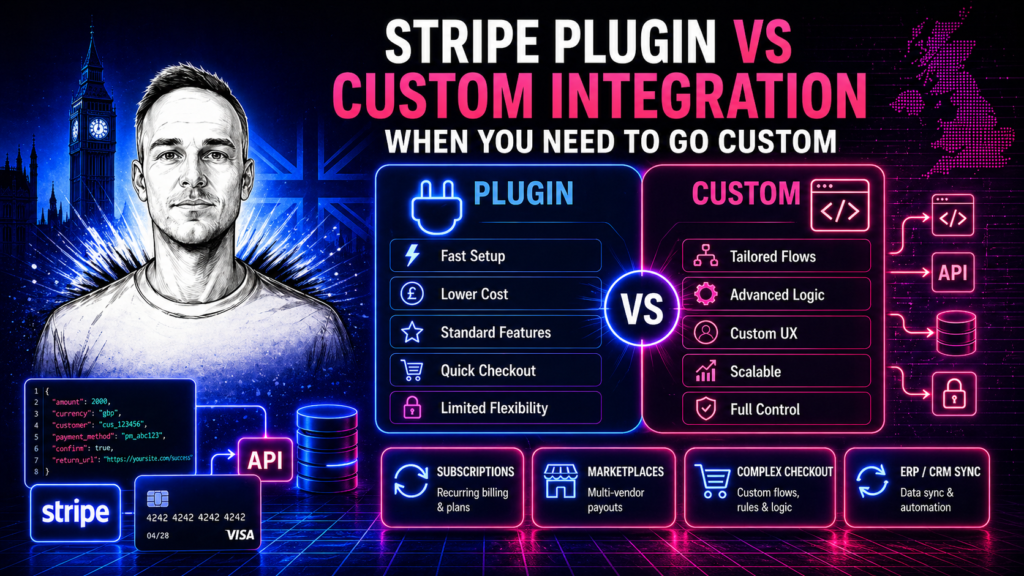
Most UK businesses that accept card payments use a Stripe plugin — WooCommerce Payments, Shopify Payments, or a similar off-the-shelf solution. For a large proportion of them, that’s the right choice. Plugins are fast to set up, well-maintained and cover standard e-commerce payment flows without any development work.
But there’s a clear point at which plugins stop working and a custom integration becomes necessary. This post explains where that line is.
What Stripe plugins do well
Stripe plugins — WooCommerce Payments, Stripe’s official WooCommerce extension, Shopify Payments, and similar — handle the standard checkout flow: customer adds items to cart, enters card details, payment is processed, order is confirmed. They handle basic subscription products if the platform supports them. They provide a Stripe dashboard link for managing refunds and disputes. They’re updated when Stripe’s API changes. They require no development work to set up.
For a straightforward e-commerce store selling physical or digital products at fixed prices, a Stripe plugin is the right choice. The build cost is zero, setup takes hours, and the ongoing maintenance is handled by the plugin developer.
Where plugins fall short
Custom subscription logic. Plugin subscription handling is rigid. If your billing model doesn’t match the plugin’s assumptions — multiple tiers, seat-based pricing, usage-based charges, custom proration rules — the plugin will fight you. You either adapt your business model to the plugin or you need a custom build.
Webhook handling. Plugins process a narrow set of Stripe webhook events and handle them in predetermined ways. They cannot trigger custom workflows — granting system access, updating a CRM, sending a personalised email sequence, flagging a customer for manual review. Any payment-triggered automation beyond basic order management requires custom webhook handling.
Stripe Connect. No mainstream plugin handles Stripe Connect. Multi-party payouts, marketplace fee calculation, connected account onboarding — all of this requires a custom build. Full stop.
Custom checkout UX. Plugins embed a standard checkout form. If your checkout flow needs to be multi-step, embedded within a larger journey, or designed to specific brand standards, a plugin’s template constraints will be a constant friction.
SaaS and platform access control. Plugins are built for e-commerce. They don’t have the concept of granting and revoking platform access based on subscription status. A SaaS product where access is controlled by payment state needs a custom integration — specifically, webhook handling that grants access when a subscription becomes active and revokes it when a subscription lapses.
B2B invoicing. Plugin invoicing is basic. Automated invoice generation from business events, payment link dispatch to clients, due date tracking and reconciliation against an accounting system all require custom Stripe Invoicing implementation.
The risk of outgrowing a plugin mid-growth
One of the most common expensive problems in SaaS development: a business builds on a plugin, grows to meaningful revenue, and then discovers that the next stage of their product — a new pricing tier, a metered billing model, a partner programme — requires the kind of custom integration they avoided at the start. At that point, migrating existing customers from a plugin-managed billing system to a custom integration is a complex, risky project.
If there’s a realistic chance that your billing model will need to become more sophisticated as you grow, starting with a custom integration — even a simple one — is cheaper in the long run than migrating later.
The honest summary
Use a plugin if: you’re running a standard e-commerce store, your subscription model is simple (flat monthly or annual, one or two tiers), and you don’t need custom payment-triggered automation.
Go custom if: your billing model has specific logic a plugin doesn’t support, you need webhook-driven automation beyond basic order management, you’re building a marketplace or multi-vendor platform, your checkout UX needs to be specific to your brand and flow, or you have a realistic roadmap that will outgrow plugin constraints.
The cost difference between a plugin (zero) and a custom integration (£1,295+) is real. But so is the cost of rebuilding a billing system after you’ve already grown into it. The right time to go custom is when your business model requires it, not when you’re already in pain.
For a clear picture of what a custom Stripe integration costs and what it includes, see the Stripe API integration service and the cost breakdown post. The live webhook event viewer demo shows the event handling that sits at the core of every custom build.
Related posts
Need a custom integration built?
I build custom API integrations — Stripe, Companies House and bespoke data pipelines. Reliable, well-documented, no agency overhead.
Discuss your project →