Stripe is free to integrate — there’s no licence fee for using the API. The cost is the development work: building the integration correctly for your specific payment model, handling webhooks reliably, and connecting Stripe to your existing platform. That cost varies significantly depending on what you’re building.
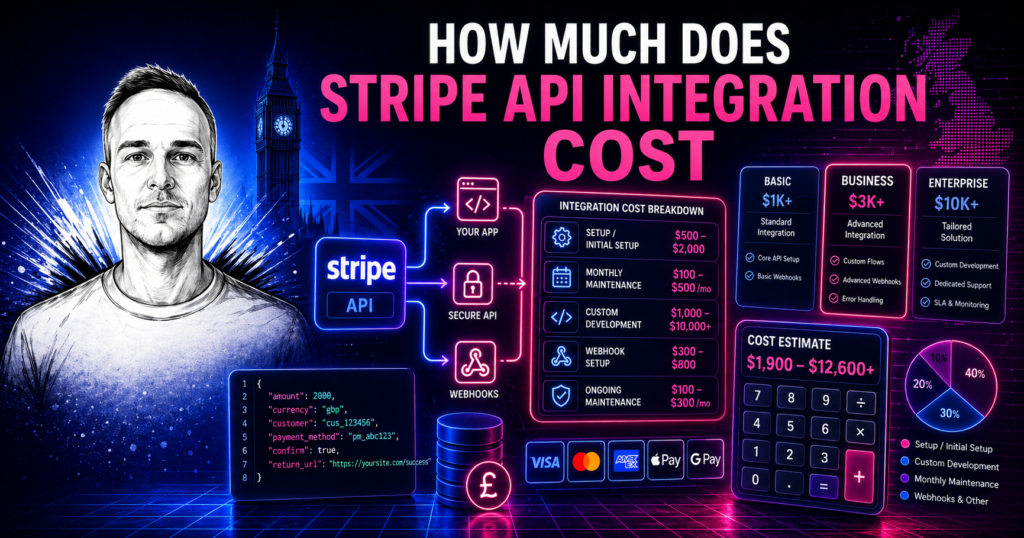
A clean one-time payment integration starts around £1,295. A full subscription billing system with webhook-driven access control runs to £2,495. A Stripe Connect marketplace build is £3,995 and upwards. Here’s what drives the price at each level.
The three tiers of Stripe integration
One-time payments: £1,295
A custom payment form using Stripe Elements or Payment Intents, wired into your website or platform. The customer enters card details, Stripe processes the payment, your platform receives confirmation via webhook and takes the appropriate action — granting access, triggering fulfilment, sending confirmation.
This tier includes: Stripe Elements or Payment Intents implementation, webhook endpoint with signature verification and idempotency handling, payment confirmation, failure and refund event handling, and error states for declined cards and network failures. Test mode testing across all payment scenarios. Technical handover document.
Typical timeline: approximately one week.
Subscription and billing: £2,495
Everything in the one-time payment tier, plus full subscription lifecycle management. Subscription creation with optional trial periods, upgrade and downgrade flows, cancellation handling, and proration. Webhook-driven access control — Stripe fires the event, your system responds automatically. Failed payment dunning flow using Stripe Smart Retries plus custom customer communication.
This is the right tier for SaaS platforms, membership sites, newsletter subscriptions, recurring service businesses and any platform where ongoing access is tied to a payment relationship with Stripe. The build implements your billing model specifically — not a generic subscription system that may not match how your business actually works.
Typical timeline: approximately two weeks.
Connect and marketplace: £3,995
Multi-party payment flows using Stripe Connect. Connected account onboarding, payment splitting and platform fee calculation, payout scheduling and dispute handling. This is the tier for marketplaces, booking platforms, service aggregators and any platform that processes payments on behalf of other businesses.
Connect adds meaningful complexity over standard Stripe integration: account type selection (Standard, Express or Custom), onboarding flow design, payment routing decisions (destination charges, direct charges or separate transfers), payout timing and dispute policy implementation. Each of these is a design decision that needs to be made correctly for your specific business model before development starts.
Typical timeline: three to four weeks.
What drives the cost up
Complex existing systems. The Stripe API side of an integration is clean and well-documented. The complexity is often in connecting it to the platform receiving the events — a legacy CRM, a bespoke membership system, a platform with restricted API access. The more unusual the receiving system, the longer the integration takes.
Custom billing logic. Standard monthly or annual subscriptions are fast to implement. Usage-based billing, seat-based pricing with proration, multiple concurrent subscriptions per customer, or complex upgrade/downgrade rules with custom proration handling all add time.
Connect account complexity. Custom accounts require more compliance work than Express accounts. Platforms with complex payout timing, multiple service provider types, or nuanced dispute policies require more careful design and more build time.
Accounting and reconciliation requirements. Platforms that need Stripe data reconciled with an accounting system — syncing invoices and payments to Xero, QuickBooks or a bespoke ledger — require additional integration work beyond the Stripe build itself.
What drives the cost down
Clean, modern platform. A platform with a well-documented REST API that can receive data cleanly is faster to integrate with. Stripe’s API is always clean — it’s the receiving end that determines complexity.
Standard billing model. Monthly flat-rate subscription with a single tier is the simplest Stripe subscription integration. The closer your model is to this, the faster the build.
Clear scope. The integration scoping conversation is where time is saved or lost. A detailed brief with clear answers to “what triggers a payment”, “what happens when a payment fails”, and “what events does my system need to respond to” produces a tighter quote and a faster build.
Stripe’s own transaction fees
Stripe charges 1.4% + 20p for European cards and 2.9% + 30p for non-European cards on standard accounts. Stripe Billing adds 0.5–0.8% for subscription management features. These fees are charged by Stripe directly and are separate from the build cost. For high-volume businesses processing over £150k/month, Stripe offers custom pricing — worth discussing with Stripe directly before committing to a pricing model.
For the full details on what’s included at each tier, see the Stripe API integration service page. You can also try the live webhook event viewer demo to see exactly how Stripe events arrive and are processed.
Related posts
Need a custom integration built?
I build custom API integrations — Stripe, Companies House and bespoke data pipelines. Reliable, well-documented, no agency overhead.
Discuss your project →