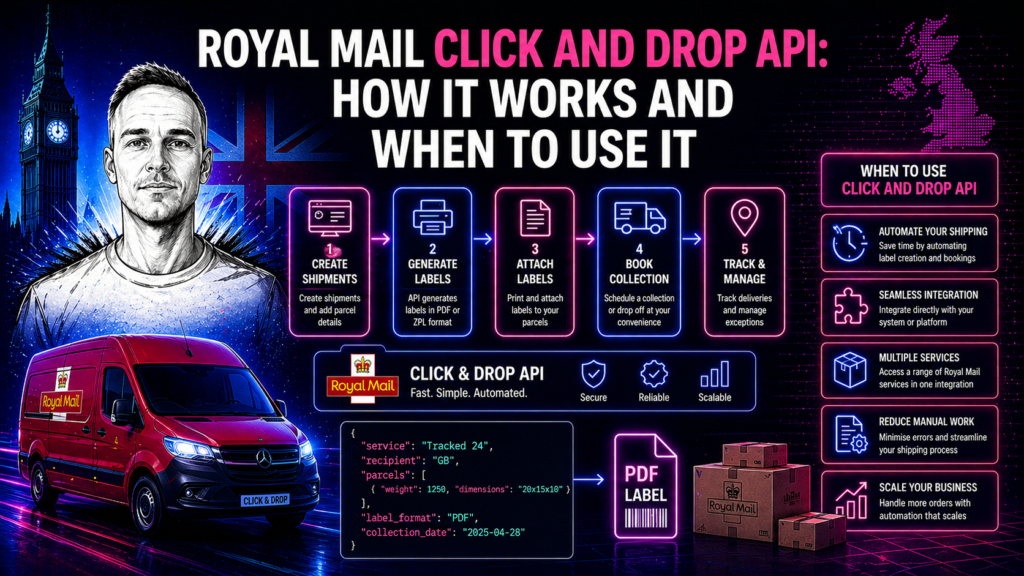
Click & Drop is Royal Mail’s despatch platform for small to medium volume businesses — typically those sending up to around 1,000 items per day. Most businesses using it interact with it manually: logging in, importing orders from a spreadsheet or marketplace, printing labels, submitting the manifest. The Click & Drop API automates all of that. Orders flow in automatically, labels generate and print without anyone touching them, and the end-of-day manifest submits on a schedule. This post covers how the Click & Drop API works, what it automates, and when it’s the right choice for your business.
What Click & Drop actually is
Click & Drop is Royal Mail’s own web-based despatch platform, separate from the API products aimed at higher-volume operations like Pro Shipping and Mailmark. It’s designed for businesses who have a Royal Mail OBA (Online Business Account) and need a structured way to create shipments, generate labels and submit manifests without needing to queue at a post office counter or negotiate a separate contract for high-volume API access.
The manual version of Click & Drop is what most small ecommerce businesses start with. You log in, manually import an order CSV or connect a marketplace, print labels and submit the manifest before your collection. The API version removes every manual step from that process.
What the Click & Drop API automates
Order import — instead of uploading a CSV or manually entering orders, your platform pushes orders directly to Click & Drop via the API the moment they’re placed. The order appears in Click & Drop ready for processing without any human involvement.
Shipment creation — once an order is in Click & Drop, the integration creates the shipment automatically, selecting the right Royal Mail service based on your configured rules. Weight-based service selection, order value thresholds, delivery speed requirements — all handled automatically.
Label generation — labels are generated immediately after shipment creation and routed to your printer queue. For businesses using thermal label printers (Zebra, Dymo, BIXOLON), the label can be in ZPL format. For standard printers, PDF is the default. The integration can trigger automatic printing without anyone having to click anything.
Tracking number capture — the tracking number for each shipment is captured from the Click & Drop API response and written back to your order management system, your WooCommerce order, or your customer record. From there it can be included automatically in your despatch confirmation email.
Manifest submission — every OBA account requires an end-of-day manifest. The integration submits this automatically at a configured time — typically 30 minutes before your collection window. A missed manifest means Royal Mail doesn’t have a record of your day’s shipments, which can cause collection delays and processing issues. Automating this removes the risk entirely.
Click & Drop API authentication
Click & Drop uses API key authentication, which is simpler than the OAuth 2.0 flow used by Royal Mail’s Pro Shipping API. You register as a developer through the Click & Drop developer portal, create an application, and receive an API key. This key goes in the header of every request to the Click & Drop API.
The API key should be stored server-side only and never exposed in client-side JavaScript. All calls to the Click & Drop API should go through a server-side proxy on your platform — your WooCommerce server, your Laravel application, or whatever powers your order management system. This keeps your Royal Mail credentials protected and means they can be rotated without touching any client-side code.
The Click & Drop developer environment includes a sandbox for testing. All integration development should happen against the sandbox before connecting to your live account. The sandbox returns realistic responses including label data and tracking numbers, so end-to-end testing is possible without generating real postage.
What the Click & Drop API can’t do
Understanding the limits of Click & Drop is as important as understanding what it can do. Click & Drop is designed for the OBA tier of Royal Mail business accounts. If your volume is approaching or exceeding 1,000 items per day consistently, you should be looking at Pro Shipping rather than Click & Drop — Pro Shipping is built for that volume and gives you more direct control over the shipment and label generation process.
Click & Drop has more limited support for complex international shipping requirements. EORI and IOSS data can be included, but businesses with high volumes of international shipments requiring detailed customs data may find Pro Shipping gives them more flexibility in how that data is structured and transmitted.
Service availability through Click & Drop is also somewhat more constrained than through Pro Shipping. The full range of Royal Mail domestic services is accessible, but some niche or enterprise services are only available through the higher-tier API products.
When Click & Drop is the right choice
Click & Drop API integration is the right choice for most UK ecommerce businesses at small to medium volumes. If you’re sending between 10 and 1,000 parcels per day, primarily to UK addresses, and your main requirement is automating the label generation and despatch process that currently takes someone time every morning — Click & Drop API is where to start.
It’s particularly well-suited to WooCommerce and custom PHP platforms, where the integration connects directly to order events and handles the full despatch flow without any manual steps. For businesses currently spending 30–60 minutes a day on manual despatch processing, the time saving from automation is immediate and significant.
It’s also the right choice if you’re not ready to commit to the higher-volume Pro Shipping API. Click & Drop has a lower approval threshold — any business with an active Royal Mail OBA can apply for developer access, whereas Pro Shipping requires a more formal approval process and a minimum volume commitment.
Click & Drop vs a WooCommerce plugin
WooCommerce plugins for Royal Mail exist, but they have significant limitations. Most connect to Click & Drop through the standard OAuth flow and handle basic shipment creation, but they can’t accommodate custom service selection logic, non-standard label formats, automatic manifest submission on a schedule, or integration with systems outside WooCommerce itself.
If your requirements are simple — you need labels generated automatically on a standard service with no custom rules — a plugin might suffice. If you need any of the following, a custom integration is the right choice: custom service selection based on order data; integration with a separate OMS or warehouse system; automatic manifest submission at a specific time; thermal printer support in a specific label format; multi-warehouse routing; or tracking data written back to a CRM rather than just WooCommerce.
A custom Click & Drop integration is also more resilient than a plugin. Plugins depend on a third-party developer maintaining compatibility with WooCommerce updates and Royal Mail API changes. A custom integration is code you own, documented and understood, that can be updated directly when something changes.
What a Click & Drop integration build looks like
A standard Click & Drop integration covers: API authentication with your Click & Drop account; order import triggered by order events on your platform; automatic service selection based on your rules; label generation in your required format and routing to your printer queue; tracking number capture and write-back to your order record; and scheduled manifest submission. The build takes approximately one to two weeks depending on the complexity of your service selection rules and the platform being integrated.
For the full service details and pricing, see the Royal Mail API integration service. For what the build costs, see the Royal Mail API integration cost guide. For WooCommerce specifically, see how to automate Royal Mail labels on WooCommerce. For a broader overview of all Royal Mail API products, see the complete Royal Mail API integration guide.
Handling manifest errors and failed shipments
A robust Click & Drop integration needs to handle failure scenarios gracefully, not just the happy path. The most common failure scenarios in production are: address validation failures for orders with malformed or undeliverable addresses; weight or dimension data missing from the order because it wasn’t set on the product in WooCommerce or your OMS; Click & Drop API unavailability causing the shipment creation request to fail; and rate limit errors on high-volume despatch days.
Each failure scenario needs a defined handler. An address validation failure should flag the order for manual review and send an internal notification — not silently fail and leave the order unshipped. A missing weight should trigger an alert to whoever manages product data. An API timeout should retry automatically after a short delay, with escalation to a manual process if retries are exhausted.
Logging every API call and response is essential for diagnosing issues. When a label doesn’t print, the first question is always whether the API call succeeded and what it returned. A comprehensive log of every request and response, with timestamps and order references, makes this diagnosis fast. Without it, debugging production issues is significantly harder.
Multi-channel and multi-warehouse considerations
Businesses selling across multiple channels — their own website, Amazon, eBay, Etsy — often want to route all orders through a single Royal Mail integration regardless of where they originated. The integration can receive order data from multiple sources, normalise it into a consistent format, and create Click & Drop shipments for all channels from a single integration point.
Multi-warehouse routing adds another layer of complexity. If you have stock at multiple locations, the integration needs to know which warehouse is fulfilling each order and route the shipment creation to the right Click & Drop account or location profile. Some businesses use a single Click & Drop account with multiple collection addresses configured; others have separate accounts per location. The right approach depends on your operational setup and is determined during scoping.
For businesses expanding into wholesale or B2B alongside their ecommerce operation, the integration can handle different service requirements per order type — retail orders using standard tracked services, wholesale orders using a different service or account — all driven by order data rather than manual decisions.
Related posts
- Royal Mail API integration: a complete guide
- How to automate Royal Mail labels on WooCommerce
- Royal Mail API integration cost
- Royal Mail Tracked 24 and Tracked 48 API integration
If you need help with a custom API integration for your website or business application, I can help. I build bespoke API integrations for UK businesses. See API integration pricing or get in touch to discuss your project.
Need a custom integration built?
I build custom API integrations — Stripe, Companies House and bespoke data pipelines. Reliable, well-documented, no agency overhead.
Discuss your project →