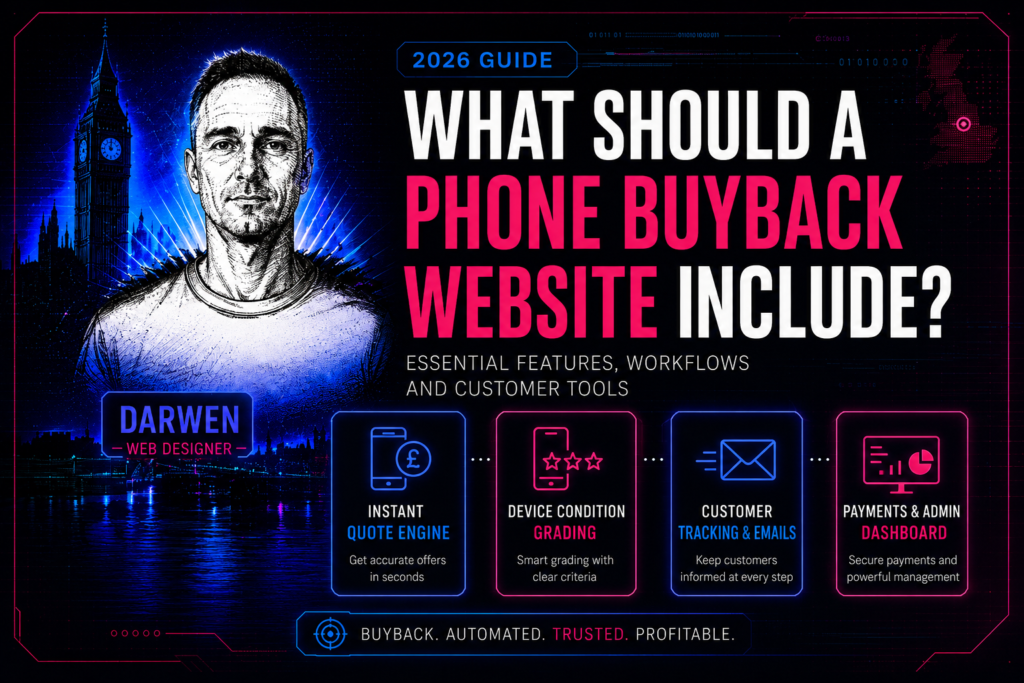
If you’re planning to launch a phone buyback website — or upgrade from the spreadsheet and manual emails you’re currently using — it helps to know what a professional trade-in platform actually needs before you start getting quotes or evaluating software.
This isn’t a five-page brochure site. A trade-in website is a transactional platform that handles real money, real devices, and real customer expectations. Here’s what it should include if you want it to work properly.
Customer-facing website
Your customers need to be able to visit your site, find their device, get a price, and book a trade-in without calling anyone or sending an email. That means:
Device selection with instant pricing. Customers search or browse by brand, then select their exact model, storage capacity, network, and condition. The price updates instantly based on their selections. No “request a quote” forms — instant, transparent pricing is what customers expect in 2026.
Condition-based grading. The price should change based on the condition the customer selects — working, good, poor, faulty. Each condition needs a clear description so customers understand what they’re selecting. Network variants (unlocked, EE, O2, Vodafone) should also affect the price if they’re relevant to your market.
Customer accounts. After booking, customers should be able to log in and see the status of their trade-in — whether their device has been received, is being tested, has been paid, or has a revised offer. This dramatically reduces “where’s my payment?” emails and gives customers confidence in the process.
Branded transactional emails. Every stage of the trade-in journey should trigger a branded email: booking confirmation with postage instructions, device received confirmation, testing results, payment sent notification, and any revised offers or dispute communications. A professional operation sends 10–15 different email types automatically. A great one sends 25+.
Mobile responsive design. The majority of your customers will be visiting on their phone — often right after deciding to sell the device they’re currently holding. If the site doesn’t work perfectly on mobile, you’re losing bookings.
Shipping and logistics
Getting devices from customers to your warehouse needs to be frictionless. The more steps you remove, the higher your conversion rate from booking to received device.
Pre-paid postage labels. The best trade-in sites generate a free pre-paid Royal Mail label automatically when a customer books. The customer prints it, sticks it on a box, and drops it at a post office. No cost to the customer, no friction. Royal Mail Click & Drop or a tracked returns service handles this.
Tracking sync. Once a device is in the post, both you and the customer should be able to see where it is. Tracking numbers pulled from Royal Mail and displayed in the customer’s account and your admin dashboard.
Reminder sequences. A significant percentage of customers book a trade-in and never send the device. Automated reminders at day 3 and day 7 after booking recover a meaningful portion of these — a friendly nudge with the postage label attached.
Admin dashboard and pipeline
Behind the customer-facing site, you need an admin panel that lets your team manage every trade-in from booking to payment.
Unified pipeline. Whether a trade-in came from your website, a walk-in customer at the counter, a bulk spreadsheet upload, or a comparison site like Compare and Recycle — it should all feed into the same pipeline. One screen, every channel.
Device grading and testing. When a device arrives, your team needs to inspect and grade it. Configurable testing checklists (screen, buttons, camera, battery, network lock, iCloud status) ensure consistent grading across staff members.
Revised offers. When a device arrives in worse condition than the customer described, you need a structured revaluation workflow — not an informal email exchange. The system should generate a revised offer, send it to the customer with a clear accept/decline choice, and handle the response automatically.
Payment processing. Processing payments one at a time through your banking app doesn’t scale. Batch payment processing — select multiple completed trade-ins, process all payments in one action — is essential once you’re handling more than 10–20 devices per week. Failed payment detection and recovery (wrong sort code, closed account) should be automatic.
Audit trail. Every action on every trade-in should be logged: who did what, when, and what changed. When a customer disputes a grading decision or claims they weren’t paid, you need the evidence immediately — not buried in email threads.
Comparison site integration
Comparison sites like CompareMyMobile, SellCell, and Compare and Recycle drive millions of visitors looking to sell their devices. If you’re not listed, you’re invisible to a large segment of the market.
A professional trade-in platform should be able to generate a pricing feed that comparison sites consume automatically, receive orders via postback when a customer books through the comparison site, and sync status updates (device received, inspected, paid) back to the comparison platform.
This turns comparison sites into an automated inbound channel rather than a manual listing management headache.
Content management and SEO
Your trade-in website needs to rank in search engines. That means:
A full CMS. You should be able to edit every page, manage a blog, update device descriptions, and control SEO metadata (titles, descriptions, Open Graph tags) without touching code or asking a developer.
Category pages. Pages for each brand (Apple, Samsung, Google) and device type (phones, tablets, laptops) that are SEO-optimised and display all available devices with current pricing.
Blog. Regular content targeting long-tail keywords in your market — “how to sell my iPhone”, “where to trade in a Samsung”, “best phone trade-in prices UK” — drives organic traffic that compounds over time.
White-label branding
The site should look like your business, not like a generic platform. That means your logo, your colours, your domain, your email sender name. The best platforms offer deep branding customisation — not just a logo upload, but full control over website colours, email colours, and the overall look and feel.
Security and data protection
You’re handling customer names, addresses, email addresses, phone numbers, bank details, and device identifiers (IMEI numbers). This data needs to be protected properly.
At minimum: encrypted sensitive fields, role-based access controls so staff only see what they need to, tenant isolation if you’re on a shared platform, rate limiting on public endpoints, and GDPR-compliant data handling with appropriate privacy policies.
Does anything like this actually exist?
Yes. This is exactly what I built with ReGraded — a complete trade-in management platform with over 150 features covering everything on this list. Every operator gets their own branded site, admin dashboard, email system, shipping integration, payment processing, and CMS — live in 48 hours from £149 per month.
I built it because I spent 20 years building ecommerce platforms and realised that every trade-in operator needs fundamentally the same system — the only differences are branding, pricing, and configuration. Building it as a SaaS platform means operators get enterprise-grade infrastructure at a fraction of what a custom build would cost.
See the full feature list — or book a demo and I’ll show you everything with your branding applied.
Need help with your website?
I work directly with small businesses on web design, WordPress fixes, Shopify support and local SEO. No agency overhead.
Get in touch →